




One of the first things many new eBike riders notice is the number on the display.
PAS 1.
PAS 2.
PAS 3.
PAS 4.
PAS 5.
But what do those numbers actually mean?
Pedal Assist System, commonly called PAS, determines how the electric motor supports you while you pedal. Instead of simply turning motor assistance on or off, different assistance levels can change the way the bike responds to your pedaling.
For a new rider, understanding PAS levels can make the difference between a bike that feels unpredictable and one that feels easy to control.
A lower PAS level may be useful when you want a lighter amount of assistance.
A higher level may be useful when climbing, accelerating, or when you want the motor to do more of the work.
But PAS numbers are not universal.
PAS 3 on one eBike does not necessarily feel the same as PAS 3 on another.
The actual experience depends on the bike's motor, controller, sensor system, programming, battery condition, rider input, terrain, and riding conditions.
This guide explains what electric bike PAS levels mean, how they work, when to use each level, how PAS affects battery consumption, and how to choose the right assistance level for different riding situations.
What Does PAS Mean on an Electric Bike?
PAS stands for Pedal Assist System.
It is the system that detects when the rider is pedaling and then provides motor assistance.
The basic process is:
Rider pedals
↓
Pedal input is detected
↓
Sensor sends information to the controller
↓
Controller determines motor assistance
↓
Motor helps propel the bike
The PAS level determines how the system is configured to respond.
Depending on the eBike, higher PAS levels may provide more assistance, stronger acceleration, higher assistance limits, or a different response from the motor.
Why Do Electric Bikes Have Different PAS Levels?
A single assistance setting would not work well for every riding situation.
Imagine riding on flat pavement.
You may not need maximum motor assistance.
Now imagine riding uphill with a heavy load.
You may want substantially more help from the motor.
Different PAS levels give the rider more control over how much assistance the bike provides.
Instead of always asking the motor for maximum output, the rider can choose an assistance level that matches the current situation.
This can make riding more comfortable and can also help manage energy consumption.
What Do PAS 1 Through PAS 5 Mean?
There is no universal industry rule that says every PAS level must provide a specific amount of power.
However, many eBikes use a structure similar to this:
PAS 1
Light assistance.
Useful for relaxed riding, flat roads, and riders who still want to do most of the pedaling.
PAS 2
Moderate assistance.
Useful for everyday riding when you want some motor support without relying heavily on the motor.
PAS 3
Balanced assistance.
Often useful for general riding, mild hills, and situations where you want a comfortable combination of pedaling and motor support.
PAS 4
Higher assistance.
Useful for stronger acceleration, longer inclines, or situations where additional motor support is helpful.
PAS 5
Maximum or near-maximum assistance.
Often used when the rider wants the strongest available pedal assistance within the bike's programmed limits.
Again, these are general descriptions.
The actual behavior depends on the individual eBike.
PAS Levels Are Not the Same as Gears
This is one of the most common misunderstandings among new eBike riders.
PAS controls motor assistance.
Your bicycle's gears control the mechanical relationship between pedaling and the drivetrain.
They perform different jobs.
For example:
Lower gear + lower PAS
can be useful for climbing while keeping your own pedaling effort manageable.
Meanwhile:
Higher gear + higher PAS
may be useful when traveling faster on suitable terrain.
Learning to use both systems together can make an eBike feel much more natural.
PAS vs Bicycle Gears
Think of it this way:
Gears
Change how difficult it is for you to pedal.
PAS
Changes how much the electric motor assists your pedaling.
You can adjust both.
For example, when approaching a hill, you might shift to a lower gear and increase PAS.
The lower gear makes pedaling easier.
The higher PAS gives you more motor assistance.
This combination can be much more effective than simply selecting maximum PAS and leaving the bike in an inappropriate gear.
How Does PAS Know When You Are Pedaling?
The answer depends on the sensor system.
Two common approaches are:
Cadence sensing
and
Torque sensing.
Cadence-based systems detect pedal movement.
Torque-based systems measure how much force the rider is applying to the pedals.
These systems can create different riding experiences.
A cadence-based system may focus on whether the pedals are turning.
A torque-based system can respond more directly to how hard the rider is pushing.
The important point is that the PAS level and the sensor type work together.
The number shown on the display does not tell the entire story.
Why PAS 1 Can Feel Different on Different Bikes
Suppose two eBikes both have PAS levels from 1 to 5.
You might expect PAS 1 to feel identical.
It does not have to.
One bike may provide very gentle assistance.
Another may provide noticeably stronger acceleration even at a low setting.
This can happen because manufacturers can configure:
- Motor response
- Current limits
- Speed limits
- Acceleration curves
- Sensor sensitivity
- Controller programming
Therefore, comparing PAS numbers between different brands is not always an apples-to-apples comparison.
Which PAS Level Should You Use?
There is no single correct PAS level.
The best setting depends on what you are doing.
A useful starting point is:
Flat road
PAS 1–2
Normal everyday riding
PAS 2–3
Moderate incline
PAS 3–4
Steeper hill or heavier load
PAS 4–5
Maximum assistance
PAS 5
These are starting points rather than strict rules.
You should adjust the level based on your speed, comfort, terrain, traffic, and riding conditions.
PAS 1: When Should You Use It?
PAS 1 is often useful when you want the bike to feel closer to a traditional bicycle while still receiving some electric assistance.
This can be a good option for:
- Flat roads
- Bike paths
- Relaxed rides
- Warm-up riding
- Riders who enjoy active pedaling
- Situations where maximum motor assistance is unnecessary
Using a lower PAS level can also make acceleration feel more gradual on some systems.
PAS 2: Everyday Assistance
PAS 2 can be a practical middle ground.
You still contribute meaningful pedal effort, but the motor helps reduce the amount of work required.
This can be useful for:
- Neighborhood riding
- Flat-to-rolling terrain
- Casual rides
- Moderate distances
- Everyday errands
For riders who do not want the motor to dominate the experience, a lower or middle PAS setting can be a comfortable choice.
PAS 3: A Balanced Setting
PAS 3 is often a useful starting point for riders who want a balanced combination of human effort and motor assistance.
It may work well for:
- General riding
- Rolling terrain
- Longer rides
- Moderate headwinds
- Light hills
- Everyday transportation
However, the actual response depends heavily on the bike's programming.
PAS 3 on a high-performance eBike can feel considerably different from PAS 3 on a lower-powered commuter model.
PAS 4: More Motor Assistance
PAS 4 is useful when the rider needs more support.
You might choose it when:
- Climbing a longer hill
- Riding into stronger wind
- Carrying additional cargo
- Accelerating onto an open road
- Reducing physical effort
Higher assistance can make difficult terrain easier.
But increased motor output generally means greater energy consumption.
PAS 5: Maximum Assistance
PAS 5 is commonly the highest setting on a five-level PAS system.
It is useful when you want the bike to provide the strongest available pedal assistance within its configured limits.
Situations may include:
- Steeper climbs
- Strong headwinds
- Heavy loads within the rated limit
- Rapid acceleration where appropriate
- Situations where you want less physical effort
Because the motor may work harder at higher assistance levels, PAS 5 is not necessarily the best choice for the entire ride.
Does Higher PAS Mean Higher Speed?
Not necessarily.
This is another common misconception.
A higher PAS level can increase motor assistance, but it does not automatically mean the bike will exceed its designed speed limit.
The relationship depends on the system.
A manufacturer may configure PAS levels based on:
- Assistance intensity
- Acceleration
- Speed thresholds
- Motor output
- Controller settings
Therefore, PAS should not be viewed simply as:
PAS 1 = slow
PAS 5 = fast
It is more accurate to think:
Higher PAS = greater motor assistance within the system's programmed limits.
Does Higher PAS Use More Battery?
In many riding conditions, higher motor assistance can increase energy consumption.
If the motor is doing more work, the electrical system generally needs to deliver more energy.
However, battery consumption depends on many factors.
These include:
- Rider weight
- Cargo
- Speed
- Terrain
- Wind
- Acceleration
- Tire pressure
- Temperature
- Riding style
- Motor efficiency
- Battery condition
That means PAS level is important, but it is only one part of the range equation.
How to Get More Range From Your eBike
If maximizing range is your priority, you do not necessarily need to ride at PAS 1 all day.
Instead, use the assistance level strategically.
For example:
Flat road → PAS 1–2
Rolling terrain → PAS 2–3
Hill → temporarily increase PAS
Downhill → reduce motor assistance
This approach allows the motor to provide more assistance when it is actually needed.
You can also help reduce energy consumption by:
- Maintaining appropriate tire pressure
- Avoiding unnecessary hard acceleration
- Keeping the bike properly maintained
- Reducing unnecessary cargo
- Choosing an appropriate riding speed
PAS and Acceleration
PAS level can affect how quickly the bike responds after you begin pedaling.
Some systems are tuned to provide gentle acceleration.
Others may respond more aggressively.
A rider who is new to eBikes should start at a lower assistance level and learn the bike's behavior before moving to higher settings.
This is particularly important with a performance-oriented electric bike.
PAS and Cornering
Motor assistance should be managed carefully when approaching corners.
A rider generally wants predictable control rather than unexpected acceleration.
Before entering a tight turn:
- Reduce speed
- Choose an appropriate PAS level
- Maintain a stable position
- Keep both hands ready for braking
- Avoid unnecessary acceleration
The goal is not to maximize motor output.
The goal is to maintain control.
PAS and Starting From a Stop
Starting from a complete stop can feel different from maintaining an established speed.
If the bike uses a cadence-based PAS system, motor assistance may begin after pedal movement is detected.
The initial response can therefore depend on:
- Sensor sensitivity
- PAS setting
- Controller programming
- Gear selection
- Rider input
A lower gear can make starting easier because the rider does not have to push against a high mechanical resistance.
PAS and Hills
Hills are one of the situations where PAS settings become especially useful.
Instead of keeping the same PAS level throughout the entire ride, you can change it according to terrain.
For example:
Approaching hill → PAS 2
↓
Steeper section → PAS 3–4
↓
Steepest section → PAS 4–5
↓
Back to flat → PAS 2
This approach allows the rider to adapt motor assistance to the road.
PAS and Heavy Loads
An eBike carrying a heavier total load requires more effort from the motor and rider.
The total load can include:
- Rider
- Cargo
- Accessories
- Passenger, where permitted
- Other equipment
The Benifore X1T PRO has an up to 400 lbs load capacity.
Within that limit, riders may find higher PAS useful when accelerating or climbing with additional weight.
However, load capacity does not mean that every riding condition will feel identical.
More weight can affect:
- Acceleration
- Braking
- Cornering
- Climbing
- Energy consumption
Ride accordingly.
PAS and Headwinds
A strong headwind can make a flat road feel like a gradual incline.
The bike needs more energy to maintain speed against increased aerodynamic resistance.
Instead of immediately using maximum assistance, riders can gradually increase PAS until the bike reaches a comfortable balance between speed and effort.
This is another example of why PAS is best treated as an adjustable tool.
PAS and Long-Distance Riding
For longer rides, constantly using the highest assistance level may not be necessary.
A more efficient strategy can be to use different PAS levels throughout the ride.
For example:
Start → PAS 2
Flat section → PAS 2
Hill → PAS 4
Cruising → PAS 2–3
Final climb → PAS 4–5
This allows you to save more battery energy during easy sections while still having higher assistance available when needed.
PAS and Rider Fitness
Different riders have different goals.
One rider may want an eBike to reduce physical effort.
Another may want the bike to support a workout.
Another may simply want to arrive without getting exhausted.
PAS levels allow riders to adjust the amount of motor assistance according to their personal needs.
This is one of the biggest advantages of an electric bike compared with a conventional bicycle.
The rider does not have to choose between:
"Do everything myself"
and
"Let the motor do everything."
The assistance level can be adjusted.
Can PAS Be Used for Exercise?
Yes.
Lower assistance levels can allow riders to contribute more of the effort.
For example, a rider might use PAS 1 or PAS 2 on flat terrain and increase assistance only when climbing.
This can make an eBike useful for riders who want to remain active while still having additional support available.
The important thing is to choose a level that matches your fitness, terrain, and riding goals.
PAS and Pedaling Technique
Motor assistance does not eliminate the importance of good pedaling.
A rider can often improve efficiency by:
- Choosing the appropriate gear
- Maintaining a comfortable cadence
- Avoiding unnecessary acceleration
- Using the correct PAS level
- Looking ahead at terrain
For example, shifting to an easier gear before a hill can make the climb smoother than waiting until the bike is already struggling.
Why Gear Selection Still Matters With a Powerful Motor
A common mistake is thinking:
"My eBike has a powerful motor, so I don't need to use the gears."
That is not necessarily true.
Gears and motor assistance solve different problems.
A powerful motor can provide substantial assistance.
But selecting the right gear can still help the rider maintain a comfortable pedaling rhythm.
The best experience often comes from combining:
Correct gear + appropriate PAS + smooth rider input
rather than relying entirely on one part of the system.
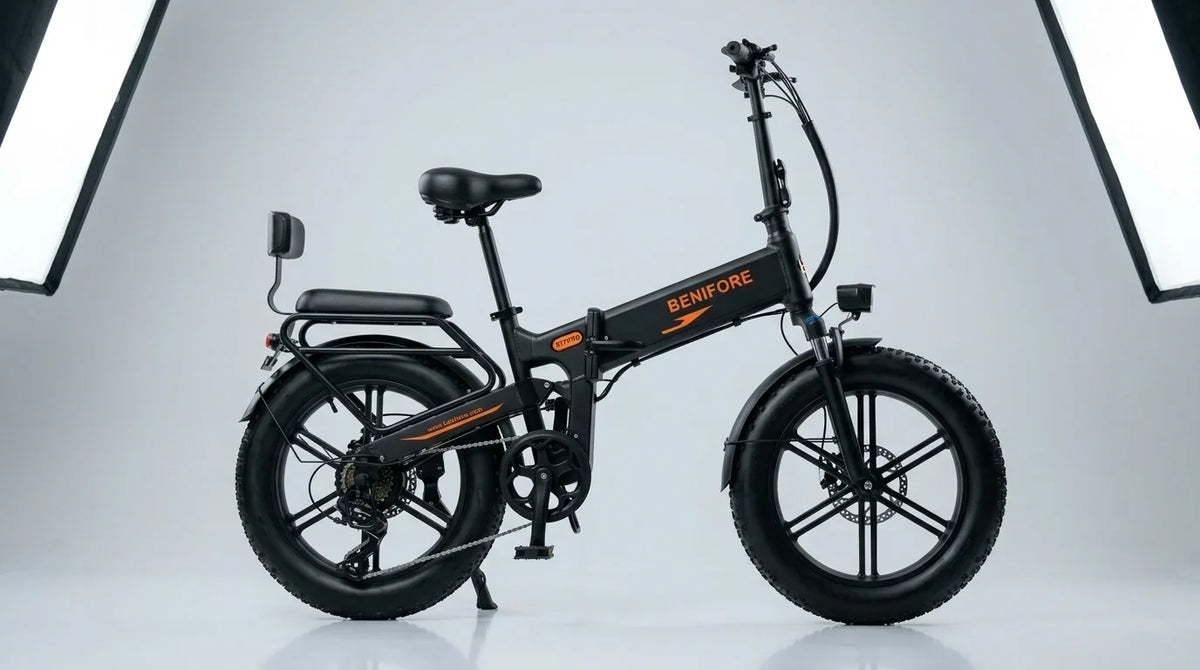
PAS on a High-Performance eBike
The Benifore X1T PRO combines:
- 1500W peak motor
- 90Nm torque
- 48V 20Ah battery
- Up to 65 miles of range
- 35 MPH top speed
- 20×4.0 fat tires
- Full suspension
- Up to 400 lbs load capacity
With a performance-oriented system like this, riders have access to substantial motor capability.
That does not mean PAS 5 should be used constantly.
In fact, understanding the different assistance levels becomes even more useful.
You may want stronger assistance when climbing or accelerating, while lower assistance can be more appropriate for relaxed cruising.
The goal is not simply to use as much power as possible.
The goal is to use the available power intelligently.
PAS Settings and Riding Comfort
The correct PAS level can affect more than speed.
It can influence how physically demanding the ride feels.
Too little assistance:
You may feel like the bike is requiring more effort than expected.
Too much assistance:
The bike may feel more aggressive than you want.
The right level:
The motor supports your riding without taking away the feeling of control.
Finding that balance is part of learning an eBike.
Why New Riders Should Start Low
If you have never ridden an eBike before, starting at the highest PAS level may not be the best idea.
Higher assistance can produce stronger acceleration.
A better approach is:
- Start in a safe open area.
- Select a low PAS level.
- Begin pedaling slowly.
- Feel how the motor responds.
- Practice braking.
- Increase PAS gradually.
- Learn how the bike behaves at different levels.
This gives you time to understand the bike before riding in traffic or crowded areas.
PAS and Braking
PAS should always be considered together with braking.
If the bike is providing motor assistance and you need to slow down, use the brakes appropriately.
On eBikes equipped with brake cutoff sensors, activating the brake can also interrupt motor assistance.
This creates a coordinated control system:
Pedaling → Motor assistance
Brake input → Motor assistance interruption
The rider should understand both before riding at higher speeds.
Does PAS Continue When You Stop Pedaling?
On a typical pedal-assist system, motor assistance is linked to detected pedaling.
When the system no longer detects the required pedal input, motor assistance should stop according to the bike's design.
The exact timing can vary.
Some systems may stop very quickly.
Others may have a slight programmed response delay.
This behavior is part of the overall controller and sensor configuration.
Why PAS Can Feel Different in Different Conditions
The same PAS level can feel different depending on the environment.
For example:
PAS 3 on flat pavement
May feel relatively strong.
PAS 3 on a steep hill
May feel much weaker because the motor is working against gravity.
PAS 3 with a strong headwind
May feel different again because aerodynamic resistance has increased.
PAS 3 with a heavy load
May require more motor effort.
Therefore, riders should evaluate PAS based on actual riding conditions rather than expecting one fixed sensation.
Common PAS Mistakes
Mistake 1: Always Using PAS 5
Maximum assistance is not necessary for every situation.
Mistake 2: Ignoring Gears
PAS does not replace mechanical gearing.
Mistake 3: Increasing PAS Too Quickly
New riders may experience stronger acceleration than expected.
Mistake 4: Assuming PAS Numbers Are Universal
PAS 3 does not necessarily mean the same thing across brands.
Mistake 5: Blaming PAS for Every Range Problem
Range depends on many variables.
Mistake 6: Forgetting to Reduce Assistance
When conditions become easier, lowering PAS can make the ride smoother and more efficient.
How to Find Your Ideal PAS Level
The easiest approach is to experiment.
Start low.
Ride on flat ground.
Increase the level one step at a time.
Pay attention to:
- Acceleration
- Pedaling effort
- Speed
- Battery consumption
- Comfort
- Control
Then repeat the process on a hill.
Over time, you will develop a personal understanding of which PAS level works best for different conditions.
A Simple PAS Strategy for Everyday Riding
A practical starting strategy could look like this:
| Riding Situation | Suggested PAS |
|---|---|
| Flat, relaxed riding | PAS 1–2 |
| Normal cruising | PAS 2–3 |
| Rolling terrain | PAS 2–3 |
| Moderate hills | PAS 3–4 |
| Strong headwind | PAS 3–4 |
| Steeper climbs | PAS 4–5 |
| Maximum assistance needed | PAS 5 |
These settings are only general guidelines.
Your actual eBike may behave differently.
Frequently Asked Questions
What does PAS mean on an electric bike?
PAS means Pedal Assist System. It controls how the motor assists the rider while pedaling.
What is PAS 1?
PAS 1 generally provides a low level of motor assistance and can be useful for relaxed riding and flat terrain.
What is PAS 5?
PAS 5 is commonly the highest assistance level on a five-level system, providing stronger motor support within the bike's programmed limits.
Does higher PAS use more battery?
Higher assistance can increase energy consumption because the motor may provide more output, although actual consumption depends on many riding conditions.
Is PAS the same as gears?
No. Gears change the mechanical pedaling ratio, while PAS controls electric motor assistance.
Does PAS control speed?
PAS can affect acceleration and assistance behavior, but the maximum speed depends on the complete eBike system and its configured limits.
Why does PAS 3 feel different between eBikes?
Manufacturers can use different sensors, controllers, power settings, acceleration curves, and software programming.
Which PAS level is best for hills?
Higher PAS levels can be useful for hills, but the appropriate setting depends on the gradient, rider weight, load, gear selection, and motor capability.
Can I use PAS for exercise?
Yes. Lower PAS levels can allow the rider to contribute more physical effort.
Should a new rider start with PAS 5?
Usually, it is better to start with a lower level in a controlled environment and gradually increase assistance as you become familiar with the bike.
Final Thoughts
PAS levels are one of the most useful features of an electric bike because they give riders control over how much motor assistance they want.
But the numbers on the display are only part of the story.
A PAS level works together with the bike's:
Sensor system
Controller
Motor
Battery
Gearing
Rider input
Terrain
Understanding these relationships makes it easier to choose the right assistance level instead of simply selecting the highest number.
For relaxed riding, lower PAS can provide enough support while allowing you to contribute more effort.
For everyday riding, a middle setting can provide a comfortable balance.
For hills, heavy loads, or strong headwinds, higher assistance can make difficult sections easier.
And when the road becomes easier again, you can lower the assistance.
That is the real purpose of PAS.
It is not simply a ranking from "slow" to "fast."
It is a way to adjust the relationship between your effort and the motor's assistance.
Once you understand how to use it, an eBike becomes much more than a bicycle with a motor.
It becomes a riding system that can adapt to the road, your energy, and the way you want to ride.
Share: