




When shopping for an electric bike, riders often focus on motor power, battery capacity, top speed, and range.
But there is another part of the riding experience that is easy to overlook:
How does the bike know when and how much you want motor assistance?
This is where pedal-assist sensors become important.
Two common technologies are torque sensors and cadence sensors.
Both can activate motor assistance when you pedal, but they measure your input differently.
A cadence sensor primarily detects whether the pedals are rotating.
A torque sensor measures the force you are applying to the pedals.
That difference can change how an electric bike feels when starting, accelerating, climbing, slowing down, and riding at different assistance levels.
There is no single sensor that is perfect for every rider.
The better choice depends on how you want your eBike to respond to your riding style.
This guide explains how torque sensors and cadence sensors work, how they differ, what each system feels like on the road, and what you should consider before choosing an electric bike.
What Is a Pedal-Assist Sensor?
A pedal-assist sensor, commonly called a PAS sensor, detects rider pedaling and communicates that information to the eBike's electrical control system.
When the system detects that the rider is pedaling, the motor can provide assistance according to the selected riding mode and system settings.
The sensor is therefore an important connection between:
Rider → Pedaling → Electrical System → Motor Assistance
Without this input, the bike would not know in the same way when the rider is actively pedaling.
Different sensor technologies interpret that input differently.
The two most commonly discussed approaches are:
- Cadence sensing
- Torque sensing
What Is a Cadence Sensor?
A cadence sensor detects pedal rotation.
In simple terms, it answers a basic question:
Are the pedals turning?
A typical cadence sensor uses a magnetic or electronic sensing system near the crank.
As the pedals rotate, the sensor detects movement and sends a signal to the controller.
Once the system detects pedaling, motor assistance can begin.
The amount of assistance depends on the eBike's programmed settings and selected assistance level.
How Does a Cadence Sensor Feel?
Cadence-based pedal assist can feel straightforward and predictable.
The rider pedals.
The sensor detects rotation.
The motor provides assistance.
Depending on the system, assistance may feel relatively consistent within a selected PAS level.
This can be appealing for riders who want the motor to do more of the work.
For example, if you are riding at a comfortable pace and do not want to put significant force into every pedal stroke, a cadence-based system can still provide motor assistance as long as the system detects pedal movement.
What Is a Torque Sensor?
A torque sensor measures the force the rider applies to the pedals.
Instead of simply detecting whether the crank is rotating, it attempts to determine how hard the rider is pedaling.
This allows the motor assistance to respond more directly to rider effort.
A simplified concept looks like this:
More pedal force → More motor assistance
Less pedal force → Less motor assistance
The exact relationship depends on the eBike's programming.
But the basic idea is that the system responds to rider effort, not just pedal movement.
How Does a Torque Sensor Feel?
Torque-sensing systems can feel more natural to riders who want the eBike to respond closely to their own effort.
If you push harder on the pedals, the motor can respond with stronger assistance.
If you ease off, assistance can decrease.
This can create a riding sensation that feels closer to riding a traditional bicycle, while still providing substantial electric assistance.
The result can be especially noticeable when accelerating or climbing.
Torque Sensor vs Cadence Sensor
The simplest comparison is:
| Feature | Torque Sensor | Cadence Sensor |
|---|---|---|
| Detects | Pedaling force | Pedal rotation |
| Assistance response | Based more on rider effort | Based more on pedal movement |
| Riding feel | More responsive to effort | More consistent assistance |
| Pedaling input | Important | Mainly movement |
| Learning curve | Can feel more natural to cyclists | Usually simple to understand |
| Rider workload | Can encourage active pedaling | Can reduce the need for strong pedaling |
| Typical advantage | Natural power response | Simple, convenient assistance |
Neither system is automatically better.
They are designed around different riding experiences.
Which Sensor Gives More Natural Assistance?
For riders who want the motor to closely follow their pedaling effort, a torque sensor can provide a more natural-feeling response.
Imagine riding up a gradual hill.
You begin pushing harder on the pedals.
A torque-sensing system can recognize the increased effort and increase assistance accordingly.
As the road becomes flat again, your pedaling force decreases.
The system can reduce assistance.
This creates a continuous relationship between:
Your effort → Motor response
With a cadence sensor, the system is primarily detecting pedal movement rather than measuring exactly how much force you are applying.
The experience can therefore feel different.
Which Sensor Is Easier for Casual Riding?
For casual riders, a cadence sensor can be very easy to understand.
You pedal and receive assistance.
You stop pedaling and assistance can stop after the system's programmed response.
There is less emphasis on how hard you push the pedals.
This can make cadence-based systems attractive to riders who primarily want an electric bike to reduce physical effort.
For riders using an eBike for relaxed cruising, errands, or recreational riding, simplicity can be a major advantage.
Which Sensor Is Better for Active Riders?
Riders who enjoy actively contributing to the ride may prefer the response of a torque sensor.
Because the system responds to pedal force, the rider can influence motor assistance through their own effort.
This can make the eBike feel more interactive.
Instead of simply selecting an assistance level and letting the bike provide a relatively consistent amount of support, the rider's pedaling becomes a larger part of the system.
This can be especially appealing to cyclists who are already accustomed to traditional bicycles.
Torque Sensors and Hill Climbing
Hill climbing is one situation where the difference between the two systems can become noticeable.
When a rider approaches a hill, pedal resistance increases.
With a torque-sensing system, increased pedal force can be detected.
The motor can then provide more assistance according to the system's settings.
With a cadence-based system, the bike primarily needs to detect that the pedals are still rotating.
The motor assistance is more dependent on the selected assistance level and system programming.
This does not mean a cadence sensor cannot climb hills.
A properly configured cadence-based eBike can still provide strong hill-climbing assistance.
The difference is primarily in how the system responds to the rider's effort.
Starting From a Stop
Starting from a complete stop is another situation where sensor behavior matters.
When you begin pedaling, the system needs to determine whether and when to activate motor assistance.
A cadence sensor detects pedal movement.
A torque sensor can respond to the force applied through the pedals.
The exact starting behavior depends on:
- Sensor design
- Controller programming
- Motor characteristics
- PAS settings
- Gear selection
- Rider input
A well-tuned system should provide predictable assistance rather than an abrupt or unexpected surge.
Why Programming Matters as Much as the Sensor
It is easy to assume:
Torque sensor = smooth
Cadence sensor = basic
But reality is more complicated.
The sensor is only one part of the system.
The controller's programming can influence:
- Response speed
- Assistance strength
- Acceleration
- Power ramp
- PAS behavior
- Current delivery
- Motor response
A well-tuned cadence system can feel very good.
A poorly tuned torque system can still feel unnatural.
Therefore, the quality of the complete electrical system matters more than simply knowing which sensor is installed.
Does a Torque Sensor Make an eBike Faster?
Not necessarily.
A torque sensor does not automatically increase an eBike's maximum speed.
Top speed depends on the complete system, including:
- Motor characteristics
- Controller configuration
- Battery voltage
- Wheel size
- Rider weight
- Terrain
- Aerodynamics
- Manufacturer settings
- Applicable regulations
The primary difference between torque and cadence sensing is how pedal assistance responds to rider input, not necessarily how fast the bike can travel.
Does a Torque Sensor Increase Range?
Not automatically.
However, the way assistance is delivered can influence how riders use the motor.
A torque-sensing system can encourage a rider to contribute more pedal effort.
If the rider uses less motor assistance during some portions of a ride, energy consumption may decrease.
But range depends on many factors.
These include:
- Battery capacity
- Speed
- Rider weight
- Terrain
- Wind
- Tire pressure
- Acceleration
- Assistance level
- Temperature
- Riding style
The sensor itself does not determine the final range.
Cadence Sensor Advantages
Cadence sensors have several practical advantages.
Simple Operation
The system primarily detects pedal movement.
Easy to Understand
Many casual riders quickly understand how the assistance works.
Less Physical Effort
The rider does not necessarily need to apply significant pedal force to receive assistance.
Convenient for Relaxed Riding
Cadence-based systems can work well for riders who want motor assistance to do much of the work.
Consistent Assistance
Depending on system programming, the selected PAS level can provide a relatively consistent riding experience.
For some riders, these characteristics are exactly what they want.
Torque Sensor Advantages
Torque sensors also have several advantages.
More Responsive to Rider Effort
The system can respond to how hard you pedal.
Natural Riding Feel
The assistance can feel more closely connected to your own movement.
Better Interaction
Riders can influence motor output through their pedaling effort.
Useful for Variable Terrain
The assistance response can change naturally as pedal force changes.
More Familiar to Cyclists
People who enjoy traditional cycling may appreciate the relationship between effort and assistance.
Are Torque Sensors More Expensive?
They can be.
Torque sensing generally requires additional sensing hardware and more sophisticated control logic.
However, price depends on the entire eBike design.
A higher-priced eBike is not automatically better simply because it uses a torque sensor.
The complete system should be evaluated.
For example:
- Motor
- Battery
- Controller
- Sensor
- Brakes
- Tires
- Suspension
- Frame
- Display
- Components
- Warranty
- Service support
A good eBike is a system, not a collection of individual specifications.
What Happens If You Stop Pedaling?
In a pedal-assist system, stopping pedal movement normally results in motor assistance stopping or reducing according to the system's programmed behavior.
With a cadence sensor, the system detects that the pedals are no longer rotating.
With a torque sensor, the system detects the absence of meaningful pedal force.
The exact response time depends on the system.
Throttle-equipped eBikes are different because the throttle can provide motor input independently of pedal movement.
Torque Sensor and Throttle Are Different
These two features should not be confused.
A torque sensor determines how the motor responds to pedal force.
A throttle allows the rider to request motor power directly through a hand control.
For example:
Pedal Assist
Rider pedals → Sensor detects input → Controller manages assistance → Motor responds
Throttle
Rider activates throttle → Controller receives throttle signal → Motor responds
An eBike can potentially have both systems.
The combination can provide riders with different ways to control motor assistance.
What Is PAS Level?
PAS stands for Pedal Assist System.
Many eBikes allow riders to choose different assistance levels.
For example, a bike may offer multiple PAS settings ranging from low assistance to high assistance.
The exact number and behavior depend on the manufacturer.
Higher assistance can generally provide more motor support, while lower assistance may require more rider input.
The sensor and controller work together to determine how that selected level is delivered.
Why PAS Levels Matter
A well-designed PAS system gives riders flexibility.
You may want low assistance when:
- Riding slowly
- Exercising
- Riding on flat roads
You may want more assistance when:
- Climbing
- Carrying additional weight
- Accelerating
- Riding against strong wind
This allows one eBike to support different riding styles.
The important point is that PAS levels are not simply "power buttons."
They are part of the relationship between rider input and motor output.
How Rider Weight Changes Sensor Behavior
Rider weight does not change the sensor itself.
But it can change how much effort is required to accelerate or climb.
A heavier total load generally means more resistance to acceleration and more force required on climbs.
With a torque sensor, this increased effort can become part of the input signal.
With a cadence sensor, the system mainly continues to detect pedal rotation.
The motor system still needs to provide enough assistance to match the riding conditions.
This is why the same eBike can feel different when ridden by different people or loaded differently.
Riding Style Matters More Than You Think
Consider two riders.
Rider A
Wants to pedal lightly and let the motor handle most of the work.
A cadence-based system may be appealing.
Rider B
Likes to pedal actively and wants the motor to respond to their effort.
A torque-sensing system may feel more natural.
Neither rider is wrong.
They simply have different expectations.
This is one of the most important things to understand when comparing pedal-assist technologies.
Which Sensor Is Better for Commuting?
There is no universal answer.
A commuter who wants predictable assistance with minimal physical effort may appreciate cadence sensing.
A commuter who wants the eBike to feel more like a traditional bicycle with additional support may prefer torque sensing.
The best choice depends on:
- Distance
- Terrain
- Traffic
- Rider fitness
- Desired effort
- Riding frequency
- Personal preference
The sensor should match the rider, not the other way around.
Which Sensor Is Better for Recreational Riding?
Recreational riding can go either way.
Some riders want to relax and enjoy the scenery.
Others want to actively pedal and use the motor as assistance rather than replacement.
For relaxed cruising, cadence sensing can be convenient.
For active riding, torque sensing can offer a more connected feel.
Again, the correct choice depends on what "riding" means to you.
Which Sensor Is Better for Hills?
Torque sensing can provide a particularly intuitive experience on changing terrain because the system can respond to increased pedal force.
However, cadence-based systems can also perform well on hills when paired with a capable motor and appropriate programming.
For hill climbing, do not evaluate the sensor alone.
Also consider:
- Motor torque
- Motor power
- Controller
- Battery
- Gearing
- Rider weight
- Total load
- Tire configuration
A strong hill-climbing eBike requires a complete system.
Do Fat Tires Change the Sensor Experience?
The sensor itself does not directly control tire behavior.
However, tire size and pressure influence rolling resistance, traction, comfort, and overall riding feel.
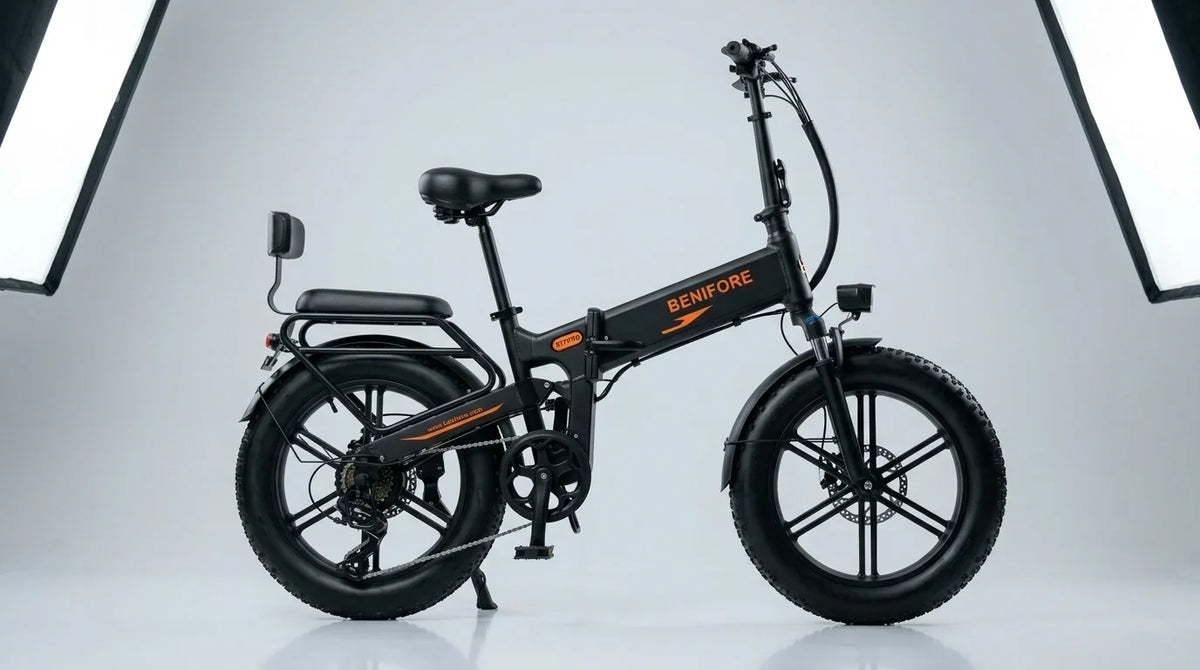
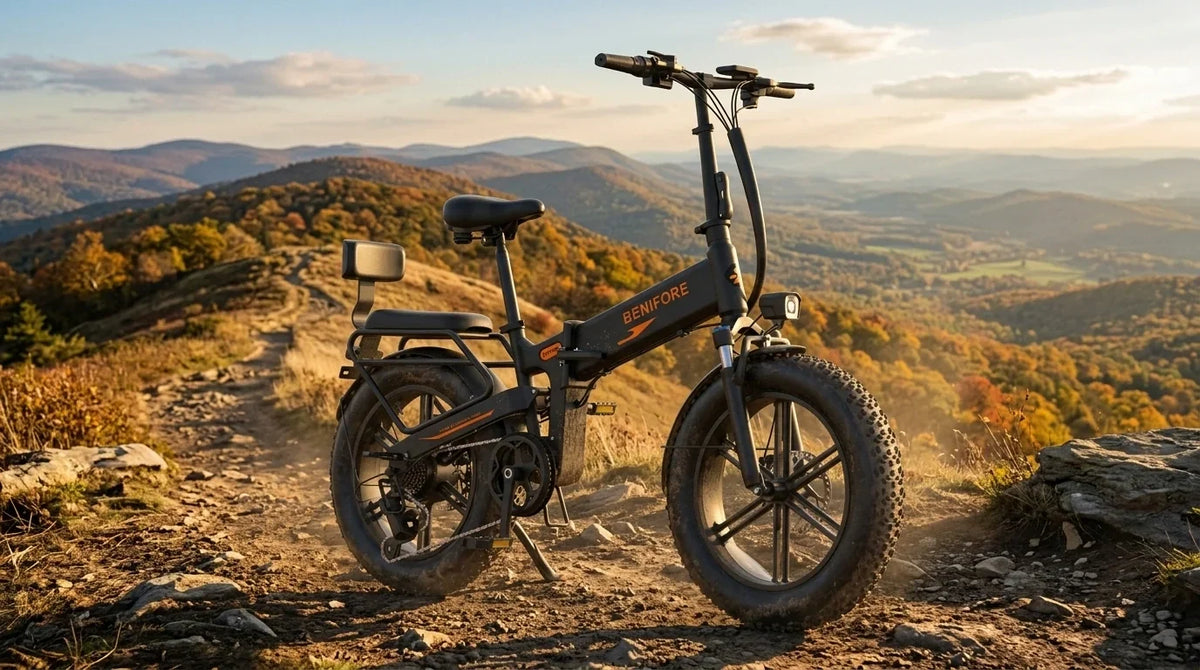
The Benifore X1T PRO uses:
20×4.0 fat tires
These wide tires are designed around stability, traction, and a more planted riding experience.
When combined with pedal assistance, the rider's perception of acceleration and control comes from the entire bike rather than the sensor alone.
This is another reason why eBike specifications should be evaluated together.
How Does Full Suspension Fit Into the Riding Experience?
Suspension does not determine whether an eBike uses a torque or cadence sensor.
However, suspension affects how the bike behaves over uneven terrain.
The Benifore X1T PRO uses full suspension.
When riding on rough surfaces, the frame and suspension system help manage impacts while the motor system continues responding to rider input.
The sensor controls motor assistance.
The suspension manages terrain impacts.
They solve different problems.
What Should You Look for When Buying an eBike?
Instead of asking only:
"Does it have a torque sensor?"
ask a broader set of questions.
How does the motor respond?
Is the acceleration smooth and predictable?
How does pedal assist feel?
Does assistance match your preferred riding style?
Can you adjust assistance levels?
More flexibility can be useful.
How does the bike behave on hills?
Consider the complete motor and drivetrain system.
Does the bike have a throttle?
If direct motor control matters to you, this may be important.
Does the system provide enough power for your weight and terrain?
Consider total load rather than rider weight alone.
Does the entire bike fit your riding style?
Sensor technology is only one part of the experience.
Common Mistakes When Comparing eBike Sensors
Mistake 1: Assuming Torque Sensors Are Always Better
A torque sensor can provide a natural riding experience, but some riders simply prefer the convenience of cadence-based assistance.
Mistake 2: Ignoring Controller Programming
The sensor sends information, but the controller determines how the system responds.
Mistake 3: Looking Only at the Sensor
Motor, battery, controller, gearing, tires, and frame design all affect the final experience.
Mistake 4: Assuming Sensor Type Determines Range
Range depends on the entire system and riding conditions.
Mistake 5: Buying Based Only on Specifications
Two bikes with similar specifications can still feel completely different on the road.
Frequently Asked Questions
What is the difference between a torque sensor and a cadence sensor?
A torque sensor measures pedal force, while a cadence sensor primarily detects pedal rotation.
Is a torque sensor better than a cadence sensor?
Not for everyone. Torque sensors can feel more natural, while cadence sensors can be simpler and more convenient.
Does a cadence sensor require hard pedaling?
Generally, no. It primarily needs to detect pedal movement, although the exact system behavior depends on the bike.
Does a torque sensor make an eBike faster?
No. Sensor type primarily affects pedal-assist response rather than maximum speed.
Does a torque sensor improve battery range?
Not automatically. Range depends on battery capacity, riding conditions, assistance level, speed, terrain, rider input, and many other factors.
Can an eBike have both a torque sensor and throttle?
Some systems can combine pedal-assist sensing with throttle control. The exact configuration depends on the manufacturer.
Are torque sensors harder to use?
Not necessarily. Many riders find them intuitive because motor assistance responds to their pedaling effort.
Which sensor is best for beginners?
It depends on the rider. Beginners who want simple assistance may prefer cadence sensing, while riders who want a more bicycle-like feel may prefer torque sensing.
Final Thoughts
The difference between a torque sensor and a cadence sensor is ultimately about how the eBike interprets your input.
A cadence sensor asks:
"Are you pedaling?"
A torque sensor asks:
"How hard are you pedaling?"
That seemingly small difference can create a noticeably different riding experience.
Cadence sensing can provide simple and convenient motor assistance.
Torque sensing can create a more responsive relationship between rider effort and motor output.
Neither technology should be judged in isolation.
The motor, controller, battery, gearing, tires, suspension, frame, and rider all contribute to how an eBike feels.
For riders comparing electric bikes, the best question is not:
"Which sensor is technically better?"
The better question is:
"Which type of assistance matches the way I want to ride?"
Once you answer that question, it becomes much easier to evaluate the rest of the eBike.
Share: