




Fishing often starts long before the first cast.
You may need to travel from a parking area to the shoreline, move along a campground road, reach a remote pond, or follow a rough trail that would be inconvenient to walk with a rod, tackle box, cooler, and other gear.
For many anglers, an electric bike can make that part of the trip much easier.
A good fishing eBike is not simply about having a powerful motor or a high top speed. The more important question is whether the bike can handle the combination of distance, uneven terrain, riding comfort, stability, cargo, and the equipment you actually bring fishing.
That makes choosing an electric bike for fishing different from choosing one primarily for commuting or recreational riding.
This guide explains what anglers should look for when choosing an electric bike for fishing, including motor performance, battery capacity, tires, suspension, load capacity, riding position, storage considerations, and real-world trail conditions.
Why Use an Electric Bike for Fishing?
Fishing locations are not always directly next to a parking lot.
Sometimes the best fishing spots require a short ride after leaving your vehicle. In other situations, anglers may want to explore several areas around a lake, campground, river, or private property without repeatedly getting back into a car.
An electric bike can provide a practical middle ground between walking and driving.
Instead of carrying fishing equipment for a long distance, an eBike can help you cover that distance with less physical effort.
It can also make it easier to move between fishing locations during the same trip.
For example, an angler might use an electric bike to:
- Ride from a campground to a nearby lake
- Travel between different shoreline access points
- Carry fishing equipment over longer distances
- Explore gravel roads around a fishing area
- Reach areas where a full-size vehicle is inconvenient
- Ride around large outdoor properties
- Combine fishing with camping and other outdoor activities
The important point is that a fishing eBike should be treated as part of the outdoor setup rather than simply another way to commute.
That changes which features matter most.
What Makes a Good Fishing Electric Bike?
There is no single specification that makes an electric bike perfect for fishing.
Instead, several characteristics work together.
A useful fishing eBike should provide a combination of:
- Stable handling
- Enough motor performance for uneven terrain
- Practical battery capacity
- Comfortable suspension
- Strong tires
- Adequate load capacity
- A comfortable riding position
- Enough space for the rider's equipment
- Predictable control on changing surfaces
The ideal setup depends on where you fish and how much equipment you normally carry.
An angler riding a paved path to a nearby lake has different requirements from someone traveling several miles over gravel, dirt, grass, or rough access roads.
1. Motor Performance Matters When Carrying Fishing Gear
One of the first specifications to consider is the motor.
Fishing equipment adds weight to the bike, and that additional weight becomes more noticeable when riding uphill, accelerating from a stop, or traveling over uneven terrain.
A motor with strong performance can make those situations easier.
However, motor wattage should not be considered by itself.
Two electric bikes can have similar advertised motor power but feel very different because of differences in torque, gearing, rider weight, battery output, tire size, and overall bike design.
Torque is particularly useful when considering an electric bike for outdoor riding.
Higher torque can help provide stronger low-speed performance when the bike is carrying additional weight or traveling over challenging terrain.
For anglers, that can matter when leaving a fishing spot with a loaded bike or climbing a gradual trail back toward the parking area.
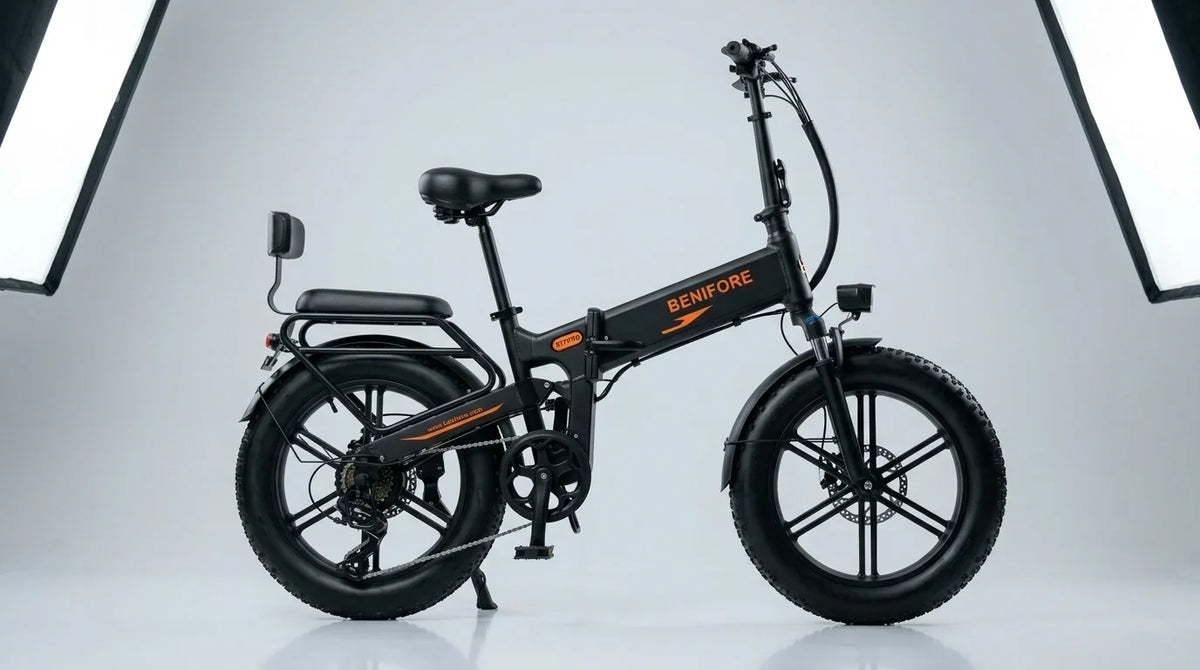
The Benifore X1T PRO, for example, uses a 1500W peak motor and 90Nm of torque.
Those specifications are useful to consider in the context of a fishing setup because the bike may be carrying both the rider and additional outdoor equipment.
The goal is not necessarily to ride faster.
The goal is to have enough available performance when the terrain or load becomes more demanding.
2. Battery Capacity Is Important for Longer Fishing Trips
Battery capacity becomes especially important when an electric bike is used for outdoor recreation.
A short commute usually has a predictable route.
Fishing trips can be different.
You may ride farther than expected, explore additional trails, or move between multiple fishing locations.
That means having enough battery capacity can provide more flexibility.
The Benifore X1T PRO uses a 48V 20Ah battery and offers up to 65 miles of range under suitable conditions.
However, advertised range should never be interpreted as a guarantee for every fishing trip.
Real-world range can vary depending on:
- Rider weight
- Cargo weight
- Riding speed
- Terrain
- Wind
- Tire pressure
- Temperature
- Stop-and-go riding
- Pedal-assist level
- Use of throttle
An angler riding slowly on relatively flat terrain may experience very different energy consumption from someone riding continuously at high speed over rough trails.
For fishing, it is generally better to plan your battery around the entire trip rather than only the distance from the parking lot to the water.
Consider the full route:
Parking → Fishing Spot → Exploration → Second Spot → Return
That total distance is what matters.
3. Fat Tires Can Be Useful Around Fishing Areas
Fishing access routes are not always smooth.
Depending on the location, you may encounter:
- Gravel
- Packed dirt
- Grass
- Sand
- Loose soil
- Uneven paths
- Small rocks
- Muddy sections
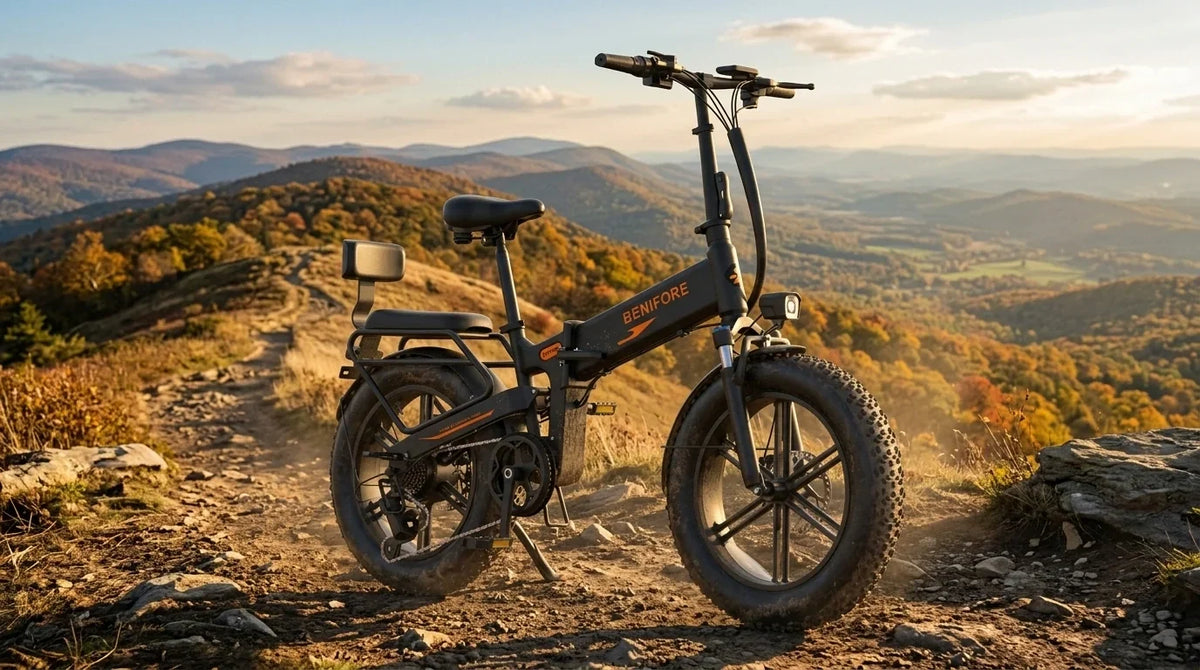
This is one reason fat tire electric bikes can be attractive for outdoor use.
The wider tire footprint can provide a more planted feeling on a variety of surfaces compared with a narrow road-oriented tire.
The Benifore X1T PRO uses 20×4.0 fat tires, giving it a substantially wider tire setup than a typical city bicycle.
For fishing, the advantage is less about appearance and more about how the bike interacts with the surface underneath it.
Wider tires can help distribute the bike's weight over a larger contact area.
They can also provide additional cushioning when properly inflated for the riding conditions.
That does not mean a fat tire eBike can safely travel through every type of terrain.
Deep mud, extremely loose sand, steep technical trails, or restricted areas can still present significant challenges.
The correct approach is to match the bike and tires to the actual environment where you plan to ride.
4. Suspension Can Make Long Outdoor Rides More Comfortable
A fishing trip can involve considerably more riding than expected.
Even when the fishing destination is relatively close, rough access roads can make the journey uncomfortable on a rigid bike.
Small bumps and repeated impacts can transfer directly through the frame and handlebars.
Suspension can help reduce some of that impact.
The X1T PRO features full suspension, combining front and rear suspension to improve comfort when riding over uneven surfaces.
For an angler, this can be useful when traveling along gravel roads, rough paths, or uneven outdoor access routes.
Suspension is not only about comfort.
Keeping the tires in better contact with the ground can also contribute to more controlled handling over uneven surfaces.
Still, suspension does not eliminate the need to ride according to conditions.
A suspension-equipped eBike is not automatically designed for every trail.
Riders should always consider the terrain, local regulations, trail restrictions, and the bike's intended use.
5. Load Capacity Matters More Than Many Anglers Expect
One of the easiest mistakes when choosing a fishing eBike is thinking only about rider weight.
Your actual riding load can include much more.
For example:
- Rider
- Fishing rod
- Tackle box
- Backpack
- Cooler
- Water
- Food
- Clothing
- Fishing accessories
- Camera
- Tools
- Other outdoor equipment
Individually, each item may seem insignificant.
Together, they can add substantial weight.
That is why the bike's total load capacity should be considered before purchasing.
The Benifore X1T PRO has an up to 400 lbs load capacity.
This provides useful headroom for riders who need to carry additional equipment, although the actual recommended load should always be distributed properly and kept within the manufacturer's guidelines.
Load capacity also affects handling.
Adding equipment high on the bike can change the center of gravity.
Heavy items should therefore be secured carefully and positioned as low and centrally as practical.
The goal is not simply to fit everything on the bike.
The goal is to maintain predictable handling while riding.
6. Think About How You Will Carry Fishing Equipment
An electric bike can have excellent motor and battery specifications, but that does not automatically make it a good fishing setup.
You also need to think about equipment organization.
Fishing gear can be awkward because rods are long while tackle boxes, coolers, and other items can be bulky.
Before a fishing trip, consider what you actually need.
A basic setup might include:
- Fishing rod and reel
- Small tackle box
- Water bottle
- Snacks
- Phone
- Sunscreen
- Small first-aid kit
- Extra clothing
- Fishing license and required documents
For longer trips, you may also want:
- Larger tackle storage
- Cooler
- Extra water
- Fishing tools
- Camera
- Portable repair equipment
Do not overload the handlebars with heavy or unstable equipment.
Handlebar-mounted loads can affect steering.
It is generally better to use a properly designed rack, basket, bag, or other compatible carrying solution that securely distributes the weight.
Before riding, check that nothing can interfere with:
- Wheels
- Brakes
- Chain or drivetrain
- Pedals
- Steering
- Suspension movement
A fishing setup should be secure before the ride begins, not adjusted while moving.
7. Stability Is Especially Important Near Water
Fishing areas often have changing surfaces.
One section may be paved, followed by gravel, grass, dirt, or a narrow access trail.
This makes stability an important consideration.
A stable electric bike should feel predictable when accelerating, braking, turning, and moving across different surfaces.
Several factors contribute to this:
- Tire width
- Wheel size
- Frame geometry
- Suspension
- Rider position
- Weight distribution
- Tire pressure
This is another reason not to choose a fishing eBike based on a single specification.
A powerful motor does not compensate for poor handling.
Likewise, a large battery does not automatically make a bike comfortable.
The entire system needs to work together.
8. Speed Is Not the Most Important Feature for Fishing
It may seem attractive to choose the fastest electric bike available.
But fishing is usually not a speed-focused activity.
In many situations, controlled riding is more valuable than maximum speed.
You may be riding around:
- Campgrounds
- Shared trails
- Pedestrian areas
- Parking areas
- Narrow paths
- Uneven access roads
- Busy recreational areas
The Benifore X1T PRO has a 35 MPH top speed, but that does not mean every ride should be made at or near that speed.
Responsible riding means adjusting speed to the environment.
When carrying fishing equipment, a slower and more controlled pace can also make it easier to manage the additional weight.
Always follow applicable local eBike laws, posted trail rules, and speed restrictions.
9. Comfort Becomes More Important on Longer Fishing Trips
A fishing eBike may be used for much longer than a normal trip around town.
You might ride several miles before reaching the water, spend hours fishing, and then ride back.
That makes comfort an important part of the buying decision.
Consider:
- Riding position
- Saddle design
- Handlebar position
- Suspension
- Tire size
- Frame geometry
- Overall bike fit
A comfortable bike encourages you to explore farther without making the ride itself feel like a chore.
For adults who use an eBike for multiple purposes, this can be especially valuable.
The same bike can potentially serve as transportation for:
- Fishing
- Camping
- Weekend recreation
- Neighborhood riding
- Outdoor exploration
- Short-distance errands
That versatility can be more useful than buying a bike designed for only one activity.
10. How to Choose a Fishing eBike Based on Your Trip
The best fishing electric bike depends heavily on your riding environment.
Short Lakeside Trips
If you mainly ride on paved roads or maintained paths, you may not need the most aggressive setup.
Focus on:
- Comfort
- Battery capacity
- Easy handling
- Practical storage
- Reliable brakes
Gravel and Dirt Access Roads
If your fishing spots require rougher access roads, consider:
- Wider tires
- Suspension
- Strong motor performance
- Stable frame geometry
- Adequate load capacity
Long Outdoor Trips
For longer trips, battery capacity becomes increasingly important.
Look for:
- Larger battery capacity
- Efficient pedal assist
- Comfortable riding position
- Secure equipment storage
- Reliable tires
- Easy-to-manage controls
Fishing and Camping Combined
If you frequently combine fishing and camping, your equipment load may be considerably higher.
In that situation, pay particular attention to:
- Total load capacity
- Cargo organization
- Range
- Tire performance
- Suspension
- Rider comfort
The more equipment you carry, the more important the complete system becomes.
Fishing eBike Checklist
Before choosing an electric bike for fishing, compare the following:
| Feature | Why It Matters for Fishing |
|---|---|
| Motor performance | Helps when carrying additional weight and riding inclines |
| Torque | Useful for low-speed acceleration and challenging terrain |
| Battery capacity | Determines how much flexibility you have for longer trips |
| Range | Helps plan trips between multiple fishing locations |
| Fat tires | Useful for gravel, dirt, grass, and other mixed surfaces |
| Suspension | Improves comfort over uneven access routes |
| Load capacity | Determines how much rider and gear weight the bike can handle |
| Riding position | Important for longer outdoor trips |
| Cargo options | Makes fishing equipment easier to transport |
| Braking system | Important when controlling a loaded bike |
| Fit | Helps maintain comfortable and predictable handling |
Looking at these features together is much more useful than choosing a bike based on one headline specification.
Benifore X1T PRO as an Outdoor Riding Example
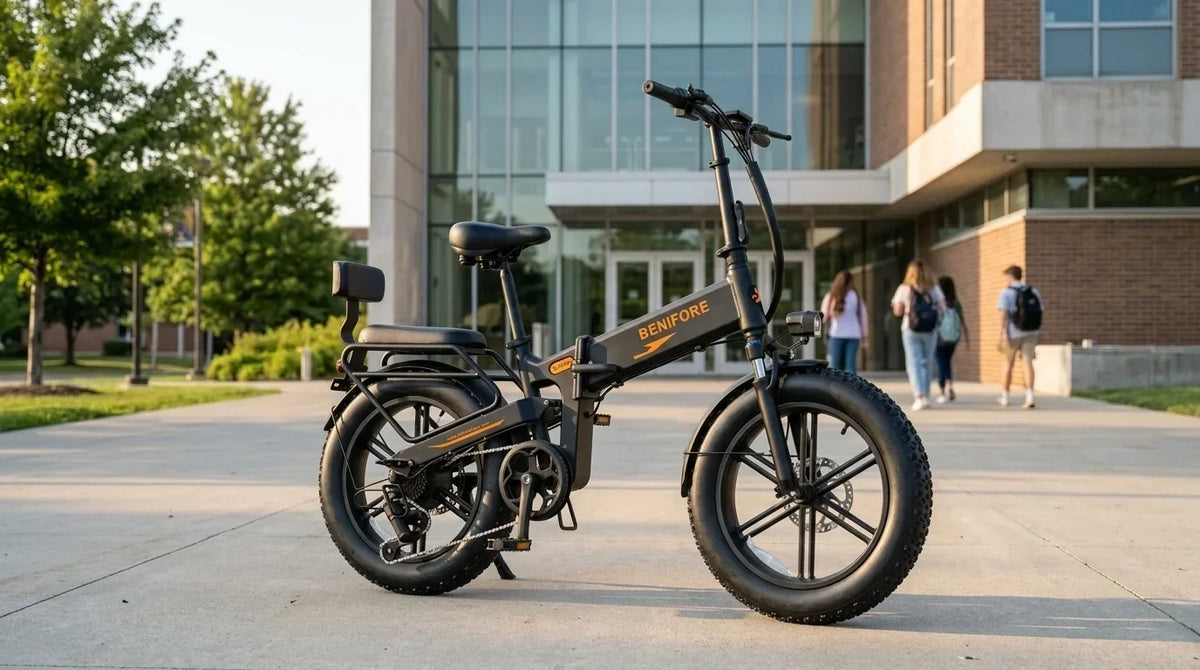
The Benifore X1T PRO is designed around a combination of performance and practical outdoor riding characteristics.
Its configuration includes:
- 1500W peak motor
- 90Nm torque
- 48V 20Ah battery
- Up to 65 miles of range
- 35 MPH top speed
- 20×4.0 fat tires
- Full suspension
- Up to 400 lbs load capacity
For an angler, these specifications address several of the common requirements of longer outdoor rides.
The motor and torque provide strong performance potential.
The 48V 20Ah battery provides substantial energy capacity for longer rides.
The 20×4.0 tires are suited to riders who want a wider tire platform for mixed outdoor surfaces.
Full suspension focuses on comfort when the route becomes less predictable.
And the up to 400 lbs load capacity provides additional room for the rider and equipment when the setup is properly configured.
That does not mean every angler needs all of these features.
Instead, the X1T PRO illustrates how several specifications can work together when an electric bike is expected to do more than simply travel on pavement.
How to Prepare an Electric Bike for a Fishing Trip
A few minutes of preparation can make the ride considerably easier.
Before leaving, check:
Battery
Make sure the battery is adequately charged for the planned round trip.
Do not plan your route around the maximum advertised range.
Leave a reasonable reserve for unexpected detours, wind, terrain, or changes in riding conditions.
Tires
Check tire pressure and inspect the tires for visible damage.
The appropriate pressure depends on the tire and riding conditions, so follow the manufacturer's recommendations rather than using a generic number.
Brakes
Test both brakes before starting.
A loaded bike can behave differently from an unloaded bike, so braking performance deserves extra attention.
Equipment
Make sure rods, bags, tackle boxes, and other equipment are securely attached.
Nothing should be able to move into the wheels, drivetrain, pedals, or steering area.
Route
Check the route before leaving.
Some trails and recreational areas restrict eBike access.
Always verify local rules before riding.
What Should You Avoid Carrying on a Fishing eBike?
Not everything belongs on the bike.
Avoid creating an unnecessarily high or unstable load.
For example, a large amount of equipment mounted high above the rear wheel can change handling.
Likewise, loose equipment attached to the handlebars can interfere with steering.
Instead of taking everything you might possibly need, build your setup around the actual fishing trip.
A lighter and better-organized load is generally easier to control.
If you need to carry substantial equipment, consider a properly rated cargo solution that is compatible with your particular eBike.
Is an Electric Bike Worth It for Fishing?
For anglers who regularly travel beyond easy walking distance, an electric bike can be a practical addition to their outdoor equipment.
Its biggest advantage is not necessarily speed.
It is access.
An eBike can make it easier to cover the distance between your vehicle, campground, home, or trailhead and the places where you actually want to fish.
It can also make it easier to explore several areas during one trip.
However, the value depends on how you fish.
If your favorite fishing spot is directly next to your vehicle, an eBike may not add much.
If you regularly explore large lakes, trails, campgrounds, rivers, or remote access roads, the value can become much more obvious.
The right bike should therefore be selected based on your actual fishing habits rather than simply choosing the bike with the largest numbers.
Final Thoughts
Choosing an electric bike for fishing requires a slightly different way of thinking than choosing a typical commuter eBike.
The question is not simply:
“How fast is it?”
Instead, consider:
“Can it comfortably and reliably get me, my equipment, and my battery reserve where I want to go?”
Motor performance, torque, battery capacity, tire design, suspension, load capacity, comfort, and equipment organization all matter.
For anglers who regularly combine fishing with camping, outdoor exploration, or longer recreational rides, a capable fat tire electric bike can become much more than transportation.
It can become another piece of outdoor gear.
The Benifore X1T PRO demonstrates this approach with a 1500W peak motor, 90Nm torque, 48V 20Ah battery, up to 65 miles of range, 35 MPH top speed, 20×4.0 fat tires, full suspension, and up to 400 lbs load capacity.
Ultimately, the best fishing eBike is the one that matches your terrain, distance, equipment, riding style, and local riding rules.
Choose those factors first, and the right specifications become much easier to identify.
Share: