




When people compare electric bike batteries, they usually look at voltage and capacity.
You might see specifications such as:
48V 20Ah
But a battery is much more than a collection of battery cells.
Inside a modern electric bike battery, there is another important electronic component called a Battery Management System, commonly known as a BMS.
The BMS helps monitor and manage the battery while it is charging, discharging, and operating under different conditions.
It can monitor factors such as voltage, current, and temperature and can help protect the battery system when operating conditions move outside its designed limits.
For eBike buyers, understanding the BMS is useful because battery performance is not determined by capacity alone.
The battery cells, BMS, charger, controller, wiring, and motor all work together as one electrical system.
This guide explains what an eBike BMS does, why it matters, how it protects the battery, and what riders should know about battery management before buying or using an electric bike.
What Is a Battery Management System?
A Battery Management System is an electronic control system designed to monitor and manage a rechargeable battery pack.
In an electric bike, the BMS is typically located inside the battery pack.
Its job is not to make the battery "more powerful."
Instead, it helps the battery operate within appropriate electrical and thermal conditions.
A simplified battery system looks like this:
Battery Cells → BMS → Electrical System
The BMS can monitor information from the battery and respond when certain conditions require protection.
Depending on the battery design, the BMS may monitor:
- Individual cell voltages
- Overall battery voltage
- Charging current
- Discharging current
- Temperature
- Battery state
- Cell balance
The exact functions vary by battery design and manufacturer.
Why Does an eBike Battery Need a BMS?
Lithium-ion battery packs contain many individual cells.
These cells need to operate within appropriate voltage and temperature ranges.
If individual cells become significantly unbalanced or the battery experiences abnormal electrical conditions, the pack may not operate as intended.
The BMS provides an additional layer of electronic management.
It can help prevent situations such as:
- Excessive charging
- Excessive discharge
- Excessive current
- Abnormal temperature
- Cell imbalance
The BMS therefore acts as an important part of the battery's protection and monitoring system.
How Does a BMS Monitor Battery Cells?
An eBike battery pack can contain multiple individual cells connected together.
The BMS monitors electrical information from the battery pack and, depending on the design, individual cell groups.
This allows the system to identify differences between portions of the battery.
For example, imagine that one group of cells reaches a higher voltage than another group during charging.
A battery management system with balancing functionality can help manage this difference.
The goal is to keep the battery pack operating more consistently rather than allowing individual cell groups to drift too far apart.
What Is Cell Balancing?
Cell balancing is one of the important functions associated with many BMS designs.
A battery pack contains multiple cell groups.
Ideally, these groups operate within a reasonably balanced range.
Over time, small differences can develop because of:
- Manufacturing variation
- Temperature
- Usage
- Cell aging
- Internal resistance differences
If these differences become significant, the usable performance of the battery pack can be affected.
A BMS with cell balancing functionality can help reduce these differences.
There are different balancing approaches, but the basic goal is similar:
Keep the cells operating together as a balanced battery pack.
Why Cell Balance Matters
Consider a battery pack made from multiple groups of cells.
If one group reaches its voltage limit before the others during charging, the entire pack may need to stop charging even though other groups have not reached the same level.
Similarly, if one group reaches a lower limit earlier during discharge, the battery system may need to stop delivering power.
This means the weakest or most limited cell group can influence the usable behavior of the entire pack.
Good battery management therefore involves more than simply adding together the capacity numbers printed on individual cells.
What Does a BMS Do During Charging?
Charging is one of the most important times for battery management.
The BMS monitors the battery while energy is being added.
Depending on the system design, it can monitor:
- Battery voltage
- Cell voltage
- Charging current
- Temperature
- Cell balance
If the system detects an abnormal condition, protection functions may activate.
This is one reason riders should use a charger that is designed for the specific eBike battery system.
The charger and BMS are not independent components.
They are part of the same charging system.
What Does a BMS Do During Riding?
The BMS also matters when the bike is being used.
During riding, the motor draws electrical energy from the battery.
The amount of current required can change significantly.
For example, electrical demand can increase during:
- Hard acceleration
- Hill climbing
- Heavy loads
- Strong headwinds
- High-speed riding
- Repeated starts and stops
The BMS monitors the battery system while this is happening.
The battery controller and motor controller may work together with the battery's protection system to keep the electrical system operating within its intended limits.
BMS and Electric Bike Controller Are Not the Same
These two components are often confused.
They perform different jobs.
Battery Management System
The BMS primarily manages and protects the battery pack.
It monitors battery-related conditions and can control battery protection functions.
Motor Controller
The motor controller manages electrical power delivered to the motor.
It processes signals from the throttle, pedal-assist system, sensors, and other components.
A simplified system can be viewed as:
Battery Cells → BMS → Motor Controller → Motor
Each component has a different role.
This is why changing one component does not automatically upgrade the entire electrical system.
BMS and Battery Capacity Are Different Specifications
A battery specification such as:
48V 20Ah
describes the battery's nominal voltage and capacity.
It does not tell you everything about the battery's internal construction.
Two batteries could have the same advertised voltage and capacity while using different:
- Cell configurations
- Cell chemistry
- Cell quality
- BMS designs
- Current limits
- Thermal management
- Physical packaging
This is one reason battery specifications should be evaluated as a complete system rather than based on one number.
What Does 48V 20Ah Mean?
The voltage and amp-hour rating describe two different characteristics.
48V refers to the nominal electrical voltage of the battery system.
20Ah refers to its nominal charge capacity.
A simplified energy calculation is:
48V × 20Ah = 960Wh
That gives a nominal energy figure of approximately 960 watt-hours.
However, this does not mean an eBike will always consume exactly 960Wh during a ride.
Real-world energy use changes depending on:
- Rider weight
- Speed
- Terrain
- Wind
- Tire pressure
- Riding mode
- Acceleration
- Temperature
- Surface conditions
This is why battery capacity and real-world range are related but not identical.
Does a Better BMS Increase Range?
A BMS does not magically increase the physical capacity of a battery.
However, battery management can influence how effectively and safely the battery system operates.
Range is primarily affected by the amount of usable energy in the battery and how much energy the bike consumes.
Energy consumption depends on many factors.
For example, riding at higher speeds generally requires more energy than riding at lower speeds.
Repeated steep climbs can also consume significantly more energy than steady riding on flat roads.
Therefore:
Battery capacity ≠ guaranteed range
The BMS is part of the system that helps manage that available energy.
Does a BMS Affect Battery Safety?
Battery safety is one of the most important reasons for using a properly designed battery management system.
Lithium-ion batteries require controlled operating conditions.
The BMS can provide electronic protection against certain abnormal conditions, depending on its design.
Potential protection functions can include:
Overcharge Protection
Helps prevent the battery from being charged beyond its designed electrical limits.
Over-Discharge Protection
Helps prevent excessive discharge.
Overcurrent Protection
Can respond when electrical current exceeds defined limits.
Short-Circuit Protection
Some BMS designs can respond to abnormal short-circuit conditions.
Temperature Monitoring
Some systems monitor battery temperature and can respond to excessive temperatures.
These functions vary between battery designs.
A BMS should therefore be viewed as one part of a complete battery safety system rather than a guarantee against every possible battery problem.
Why Temperature Matters to an eBike Battery
Temperature can affect battery performance.
Very hot or very cold conditions can change how a lithium-ion battery behaves.
High temperatures can increase stress on battery components.
Low temperatures can temporarily reduce available battery performance.
This means that the same eBike may behave differently on a hot summer afternoon compared with a cold winter morning.
Battery management systems that include temperature monitoring can use that information as part of the battery's protection strategy.
However, riders should still follow the manufacturer's charging, storage, and operating recommendations.
Why Battery Temperature Can Change During a Ride
Battery temperature can change because of electrical load and environmental conditions.
For example, repeated high-power acceleration can increase electrical demand.
Long climbs can also require sustained power.
If the bike is being ridden in a hot environment, the surrounding temperature adds another source of thermal stress.
The battery enclosure can also influence heat management.
This is why battery design is not simply about how many cells fit inside a case.
The physical design, electrical system, and thermal environment all matter.
What Happens If the BMS Detects a Problem?
The exact response depends on the battery and BMS design.
Possible responses can include:
- Limiting current
- Disconnecting the battery output
- Stopping charging
- Showing a warning
- Producing an error indication
If an eBike suddenly loses power, it does not automatically mean that the motor has failed.
Possible causes can include:
- Battery protection activation
- Low battery voltage
- Controller issues
- Wiring problems
- Sensor problems
- Motor problems
- Connector issues
Proper diagnosis is important before replacing expensive components.
Why You Should Not Bypass the BMS
Some riders may see online discussions about removing or bypassing battery protection systems to increase current or performance.
This is not a modification that should be taken lightly.
The BMS exists for a reason.
Bypassing or replacing it with an incompatible system can change:
- Current limits
- Charging behavior
- Protection thresholds
- Cell balancing
- Temperature monitoring
- Electrical stress
The result may be an electrical system operating outside its original design.
For an eBike battery, compatibility and proper protection are more important than simply trying to increase electrical output.
Can You Replace an eBike BMS?
In some battery packs, the BMS can technically be replaced.
However, this is not a universal DIY upgrade.
The replacement needs to be compatible with:
- Battery voltage
- Cell configuration
- Current requirements
- Charging system
- Cell chemistry
- Connector configuration
- Physical dimensions
- Protection settings
Incorrect installation can create serious electrical risks.
For this reason, battery repair or BMS replacement should be handled by a qualified technician familiar with lithium-ion battery systems.
What Is a Smart BMS?
Some newer battery management systems provide more information than basic protection systems.
A smart BMS may be capable of communicating information such as:
- Battery voltage
- Current
- Temperature
- State of charge
- Cell voltage
- Fault information
- Cycle information
Depending on the system, this information may be available through a display, diagnostic interface, or other communication method.
Smart battery management can make battery diagnostics easier because more information is available.
However, "smart" does not automatically mean "better."
The system still needs to be appropriately designed for the battery pack.
What Is Battery State of Charge?
State of charge, often abbreviated as SOC, refers to how much usable energy remains relative to the battery's available capacity.
For example:
100% SOC
generally indicates a fully charged battery.
50% SOC
generally indicates that approximately half of the usable energy remains.
The exact percentage displayed by an eBike may be an estimate.
Battery voltage changes during discharge, and the relationship between voltage and remaining capacity is not perfectly linear.
This is one reason battery percentage displays can sometimes appear to change differently under load.
Why Battery Percentage Can Change During a Ride
You may notice that an eBike battery indicator changes while climbing or accelerating.
This can happen because electrical load causes the battery voltage to temporarily change.
Under higher current demand, the measured voltage can drop.
When the load decreases, voltage can recover somewhat.
This is sometimes referred to as voltage sag.
The rider may therefore see the battery indicator behave differently during:
- Hard acceleration
- Steep climbs
- High-power riding
- Heavy loads
This does not necessarily mean that the battery suddenly lost a large amount of energy.
It can be partly related to how battery voltage responds under load.
What Is Voltage Sag?
Voltage sag is a temporary reduction in measured battery voltage when the battery is supplying current.
The amount of voltage sag depends on factors such as:
- Battery chemistry
- Cell quality
- Internal resistance
- Temperature
- Current demand
- Battery age
- Battery state of charge
A battery with lower internal resistance may experience less voltage drop under the same load.
This is another reason why two batteries with the same nominal voltage and capacity can behave differently.
Does Battery Age Affect the BMS?
The BMS itself may continue operating normally as the battery ages.
However, the battery cells it monitors gradually change with use.
Over time, battery capacity can decrease.
Internal resistance can increase.
The battery may also become less capable of delivering high current efficiently.
The BMS continues to monitor the system, but it cannot restore cells to their original condition.
This distinction is important:
Battery management can protect and monitor a battery, but it cannot reverse normal cell aging.
How Can Riders Help Maintain Battery Health?
Riders can help by following the battery manufacturer's recommendations.
Good general practices include:
- Use the correct charger
- Avoid unauthorized electrical modifications
- Store the battery appropriately
- Avoid extreme temperatures when possible
- Inspect the battery enclosure
- Keep electrical connectors in good condition
- Follow recommended charging procedures
- Do not continue using a visibly damaged battery
Battery care is not complicated, but consistency matters.
Why Charger Compatibility Matters
The charger is part of the battery charging system.
Using an incompatible charger can create electrical problems.
Before charging an eBike, verify:
- Voltage compatibility
- Connector compatibility
- Charger specifications
- Manufacturer recommendations
Do not assume that two chargers are interchangeable simply because the connectors look similar.
Electrical compatibility matters more than physical appearance.
Why a Damaged Battery Should Not Be Ignored
If an eBike battery has been physically damaged, exposed to unusual heat, swollen, leaking, or behaving abnormally, it should not simply be placed back on the charger.
Battery damage can create risks that are not visible from normal operation.
When a lithium-ion battery shows abnormal physical or electrical behavior, stop using it and seek appropriate professional guidance.
Do not attempt to open or repair a damaged battery unless you are qualified to work with high-energy lithium-ion battery systems.
BMS and High-Performance Electric Bikes
The importance of battery management becomes even more apparent when looking at a performance-oriented eBike.
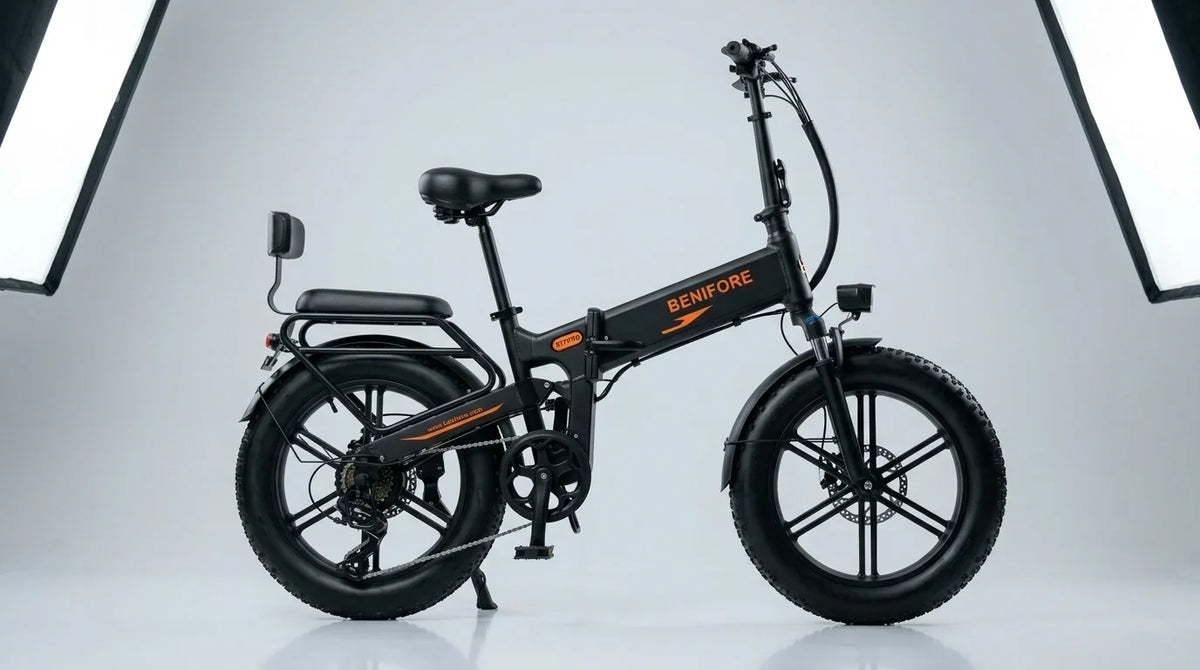
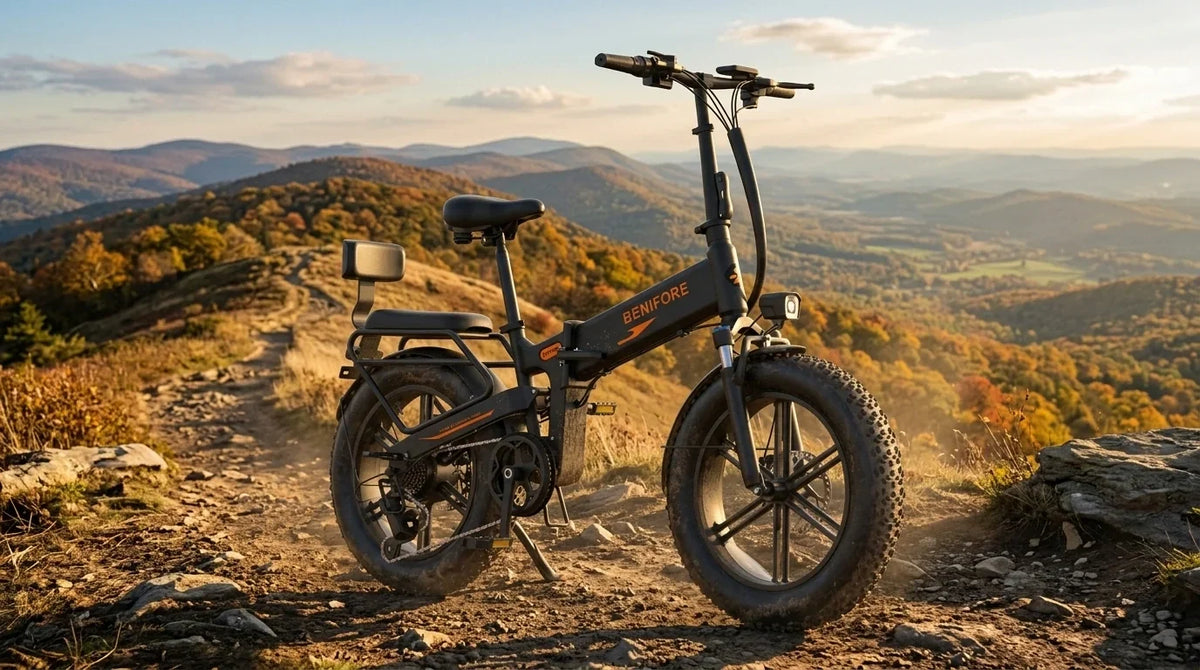
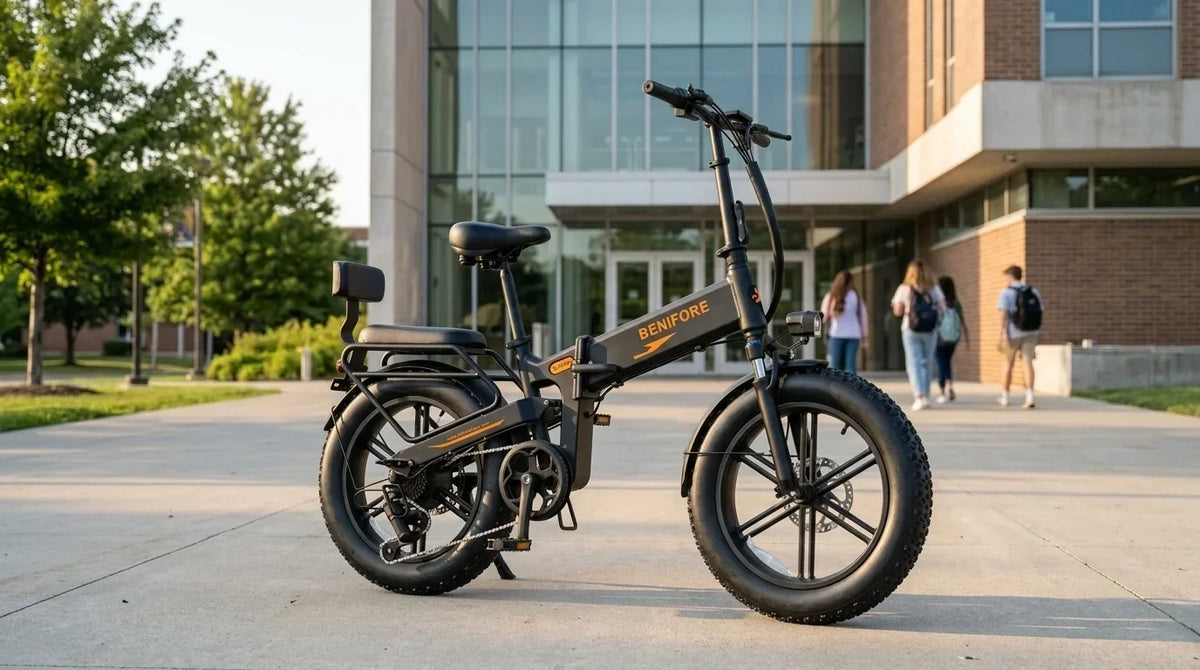
The Benifore X1T PRO uses:
- 1500W peak motor
- 90Nm torque
- 48V 20Ah battery
- Up to 65 miles of range
- 35 MPH top speed
- 20×4.0 fat tires
- Full suspension
- Up to 400 lbs load capacity
A system with this type of performance capability can experience significantly different electrical demands depending on how it is ridden.
For example, climbing with a heavier load can require substantially more electrical power than cruising on level pavement.
The battery, BMS, controller, and motor therefore need to operate together as a complete system.
This is one reason why evaluating an eBike solely by motor wattage or battery amp-hours does not provide the complete picture.
What Should You Ask About an eBike Battery?
When comparing eBikes, consider more than:
"How many amp-hours does the battery have?"
Useful questions include:
What is the battery voltage?
This determines the electrical system architecture.
What is the nominal capacity?
This provides an indication of stored energy.
What battery cells are used?
Cell quality can influence performance and longevity.
What BMS is used?
The BMS is part of the battery's protection and management system.
What charger is included?
Charger compatibility is important.
How is the battery protected?
Physical protection and electrical protection both matter.
Is replacement support available?
Long-term battery serviceability is worth considering before buying.
Frequently Asked Questions
What does BMS stand for on an electric bike?
BMS stands for Battery Management System. It is an electronic system that monitors and manages the battery pack.
Does every eBike battery have a BMS?
Modern lithium-ion eBike battery packs generally use battery management electronics, although the exact architecture and capabilities can differ between products.
Does the BMS control the motor?
Not directly. The motor controller manages motor operation, while the BMS primarily manages and protects the battery.
Can a BMS increase battery range?
A BMS does not increase the physical capacity of the battery. It helps manage the battery within its intended operating conditions.
What happens when a BMS shuts down the battery?
Depending on the design, the BMS may disconnect battery output or charging when it detects a condition that requires protection.
Can I use another BMS with my eBike battery?
Not without verifying compatibility. The BMS must match the battery's voltage, cell configuration, current requirements, charging system, and other characteristics.
Does cold weather affect the BMS?
The battery itself is affected by temperature, and a BMS with temperature monitoring can respond to operating conditions. Riders should follow the battery manufacturer's temperature recommendations.
Does the BMS make an eBike battery last forever?
No. The BMS can help manage and protect the battery, but lithium-ion cells naturally age over time.
Final Thoughts
The Battery Management System is one of the most important components inside an electric bike battery, even though riders rarely see it.
It monitors the battery, helps manage charging and discharging, and can provide protection against certain abnormal operating conditions.
More importantly, it shows why an eBike battery should not be judged by capacity alone.
A 48V 20Ah battery specification tells you useful information, but it does not tell the entire story.
Battery cells, BMS, charger, controller, motor, wiring, thermal conditions, rider weight, terrain, and riding style all contribute to how the electrical system performs.
For a high-performance eBike such as the Benifore X1T PRO, understanding these components gives riders a more realistic picture of what is happening behind the numbers.
The best way to evaluate an electric bike is not to focus on one specification.
Look at the entire system.
Battery capacity provides the energy.
The BMS manages and protects the battery.
The controller regulates power delivery.
The motor converts electrical energy into movement.
The rider determines how the system is used.
When these components are properly matched, the result is a more predictable and useful electric bike.
Share: