




For outdoor enthusiasts, getting to a hunting area is often just as important as what happens after arriving. A good route may involve gravel roads, forest trails, open fields, uneven ground, or long stretches where a conventional vehicle is not practical.
This is where an electric bike can become a useful part of an outdoor setup.
An electric bike for hunting is not simply about having a powerful motor. The right setup needs to balance traction, range, carrying capacity, comfort, durability, and controllability. Riders may need to travel several miles before reaching their destination while carrying outdoor equipment and dealing with changing terrain.
For that reason, choosing an eBike for hunting requires a different approach from choosing one primarily for commuting or casual neighborhood riding.
This guide explains what outdoor riders should consider when choosing an electric bike for hunting, how different features affect real-world performance, and what makes a practical hunting eBike useful beyond the trail.
Why Use an Electric Bike for Hunting?
Traditional transportation works well on roads, but outdoor environments can be much less predictable.
A hunting route may include:
- Gravel roads
- Dirt trails
- Grass
- Forest paths
- Uneven ground
- Steep sections
- Loose surfaces
- Long distances between access points
Walking these distances can require considerable time and energy. A vehicle may provide transportation to an access point, but it may not be able to continue through narrower trails or areas with limited vehicle access.
An electric bike provides another option.
With pedal assistance and a capable motor, riders can travel farther while reducing the physical effort required to cover longer distances.
The biggest advantage is flexibility.
Instead of treating transportation and outdoor activity as two separate parts of the trip, an eBike can become part of the entire journey.
What Makes a Good Hunting Electric Bike?
There is no single specification that determines whether an electric bike is suitable for outdoor hunting trips.
Instead, several features need to work together.
A practical hunting eBike should provide:
- Stable handling
- Sufficient motor performance
- Useful battery capacity
- Strong tires
- Comfortable suspension
- Adequate payload capacity
- Reliable braking
- A frame that can handle outdoor conditions
The importance of each feature depends on the rider, terrain, distance, and amount of equipment being carried.
1. Motor Performance Matters on Uneven Terrain
Outdoor riding can place more demand on an electric bike than flat pavement.
When a rider travels over gravel, grass, dirt, or inclines, the motor needs to maintain useful assistance without making the bike difficult to control.
Motor power is one part of this equation.
Torque is another.
Torque describes the rotational force available from the motor. In practical riding, sufficient torque can help an eBike accelerate more effectively from slower speeds and handle changes in elevation, especially when the rider and gear add additional weight.
For outdoor riding, looking at motor wattage alone does not tell the complete story.
A useful evaluation should consider:
- Rated motor power
- Peak motor output
- Torque
- Rider weight
- Gear weight
- Terrain
- Riding mode
This gives a much more realistic picture of how the bike will perform.
2. Battery Range Is More Important When Riding Remotely
Battery planning becomes especially important when riding away from developed areas.
A rider may not have access to a convenient charging point during the trip. Because of this, the battery should provide enough capacity for the planned route with a reasonable margin.
Actual eBike range is affected by many factors, including:
- Rider weight
- Cargo weight
- Riding speed
- Terrain
- Wind
- Temperature
- Tire pressure
- Assist level
- Stop-and-go riding
This means advertised maximum range should not automatically be treated as the distance every rider will achieve.
For a longer outdoor trip, it is better to think about range as a planning variable rather than a fixed number.
A rider who travels mostly on flat terrain using lower assistance may achieve significantly different results from someone riding faster over rough or hilly ground.
3. Tire Choice Can Change the Entire Riding Experience
Tires are one of the most noticeable differences between a standard commuter eBike and an outdoor-oriented model.
Narrow tires can work extremely well on pavement, but outdoor routes may include loose or uneven surfaces.
Wider tires can provide a larger contact area with the ground and help improve stability when riding across:
- Gravel
- Grass
- Dirt
- Soft ground
- Uneven trails
Fat tires can also provide additional cushioning when combined with appropriate tire pressure and suspension.
However, wider tires do not eliminate the need for good riding technique.
Riders should still adjust their speed to the terrain and avoid aggressive cornering on loose surfaces.
4. Suspension Helps on Long Outdoor Routes
A hunting route may look relatively smooth from a distance but feel very different from the saddle.
Small rocks, roots, holes, and uneven sections can create repeated impacts.
A suspension system can help reduce the amount of vibration transferred to the rider.
This can be particularly useful when:
- Riding for longer periods
- Carrying additional equipment
- Traveling over rough surfaces
- Exploring unfamiliar trails
Comfort is not simply a luxury.
When a rider is more comfortable, it becomes easier to maintain consistent control and attention throughout a longer ride.
5. Payload Capacity Deserves More Attention
One of the easiest specifications to overlook is payload capacity.
The rider is only part of the total load.
Outdoor equipment can include:
- Backpack
- Water
- Food
- Clothing
- Navigation equipment
- Fishing or camping equipment
- Tools
- Safety equipment
- Other personal gear
All of this adds weight.
A bike that feels excellent with a lightweight rider and no equipment may behave differently when carrying additional cargo.
A higher payload rating gives riders more flexibility when planning an outdoor trip.
The important point is that payload capacity should include the rider and the equipment carried on the bike.
6. Braking Performance Is Essential
Outdoor terrain can change quickly.
A flat gravel section may suddenly transition into a downhill section or a tighter trail.
A capable braking system provides riders with better control when speed needs to be reduced.
When evaluating an electric bike for outdoor use, consider:
- Brake type
- Rotor size
- Brake feel
- Stopping consistency
- Performance under load
The heavier the combined rider and equipment weight, the more important predictable braking becomes.
Braking should always be adapted to terrain and conditions rather than relying on the bike's maximum advertised speed.
7. Stability Is Often More Important Than Maximum Speed
High-speed specifications can be attractive when shopping for an electric bike, but outdoor riding is rarely about maintaining maximum speed all the time.
On a narrow trail, loose gravel, or uneven surface, control matters more than speed.
A stable riding position can make it easier to:
- Maintain balance
- Control the bike at lower speeds
- Navigate uneven terrain
- Carry additional equipment
- React to changing surfaces
This is especially relevant for riders who plan to use an eBike for outdoor exploration rather than only road riding.
A good hunting eBike should feel predictable.
Choosing an Electric Bike Based on Hunting Terrain
Different environments place different demands on an eBike.
Gravel Roads
Gravel roads are generally easier to navigate than technical trails, but loose stones can still affect traction.
Useful features include:
- Wider tires
- Stable frame geometry
- Good braking
- Comfortable suspension
Riders should reduce speed when entering loose sections.
Forest Trails
Forest trails can include roots, rocks, uneven ground, and narrow sections.
Suspension and tire performance become more important here.
A compact and stable eBike can also be easier to manage when navigating tighter paths.
Open Fields
Grass and open terrain may appear simple, but wet conditions can make surfaces significantly less predictable.
Traction becomes particularly important after rain.
Riders should avoid assuming that a powerful motor automatically guarantees traction.
The tires still need to maintain contact with the surface.
Hills and Elevation Changes
Hills place additional demand on the motor and battery.
This is where torque becomes particularly useful.
Riders should also remember that repeated climbing consumes more battery than steady riding on flat ground.
When planning a longer route with significant elevation changes, leave additional battery capacity rather than planning around the maximum advertised range.
Can a Hunting eBike Carry Outdoor Equipment?
Yes, but carrying equipment requires planning.
The safest approach is to keep heavier items low and secure.
Loose equipment can affect handling, especially when riding over uneven ground.
When preparing the bike:
Keep Weight Balanced
Avoid placing most of the weight on one side.
Secure Everything
Equipment should not shift during acceleration, braking, or turns.
Keep Important Controls Clear
Cargo should never interfere with:
- Brakes
- Handlebars
- Pedals
- Wheels
- Lights
- Battery access
Avoid Overloading
Always remain within the manufacturer's rated payload.
The goal is not simply to carry as much as possible.
The goal is to maintain predictable handling while carrying the equipment actually needed for the trip.
How Far Should You Ride on a Hunting Trip?
There is no universal answer.
A short trip might only require a few miles of riding.
A larger outdoor route could involve substantially more distance.
The correct approach is to calculate the entire trip rather than only the one-way distance.
For example, consider:
- Distance from the starting point to the destination
- Distance between different locations
- Return distance
- Possible detours
- Terrain
- Weather
- Battery reserve
If a route requires 10 miles of riding each way, the battery should not be planned around a theoretical 20-mile maximum.
Real-world conditions can reduce range.
A reserve provides flexibility if the route changes or conditions become more difficult than expected.
What About Noise?
Noise can be an important consideration during outdoor activities.
Compared with conventional gasoline-powered transportation, electric bicycles operate much more quietly.
However, quiet operation does not mean completely silent operation.
Tires, drivetrain components, brakes, and the motor can all produce some sound.
Riders should therefore focus on controlled, responsible riding rather than assuming an eBike is completely silent.
Speed, terrain, and riding technique also influence how noticeable a bicycle is in an outdoor environment.
Legal and Access Considerations
Before using an electric bike for hunting or other outdoor activities, riders should check the rules that apply to the specific area.
Access policies can vary between:
- Public lands
- State-managed areas
- Private property
- Parks
- Trail systems
- Wildlife management areas
Electric bicycle classifications and permitted access can also vary by location.
A route that allows conventional bicycles may not necessarily have identical rules for every class of eBike.
Always verify current local regulations, trail access rules, and land-management requirements before starting a trip.
This is especially important for riders traveling to a new state or unfamiliar outdoor area.
Preparing Your eBike Before an Outdoor Trip
A few minutes of preparation can prevent many avoidable problems.
Check Tire Pressure
Tire pressure affects:
- Comfort
- Traction
- Rolling resistance
- Handling
Use the manufacturer's recommended pressure range and adjust appropriately for the riding conditions.
Inspect the Brakes
Check that the brake levers feel normal and that the braking system does not show obvious signs of damage or excessive wear.
Check the Battery
Start with a properly charged battery.
If the trip is long, consider whether additional charging options are available.
Inspect the Drivetrain
Check the chain, gears, and other drivetrain components before a longer ride.
Outdoor dirt can accumulate quickly, particularly after riding through wet or muddy terrain.
Test Your Equipment
Do not wait until the day of a major trip to discover that your equipment does not fit securely.
Take a short test ride with your planned gear.
This helps identify:
- Loose bags
- Poor weight distribution
- Uncomfortable cargo placement
- Handling changes
Benifore X1T PRO for Outdoor Riding
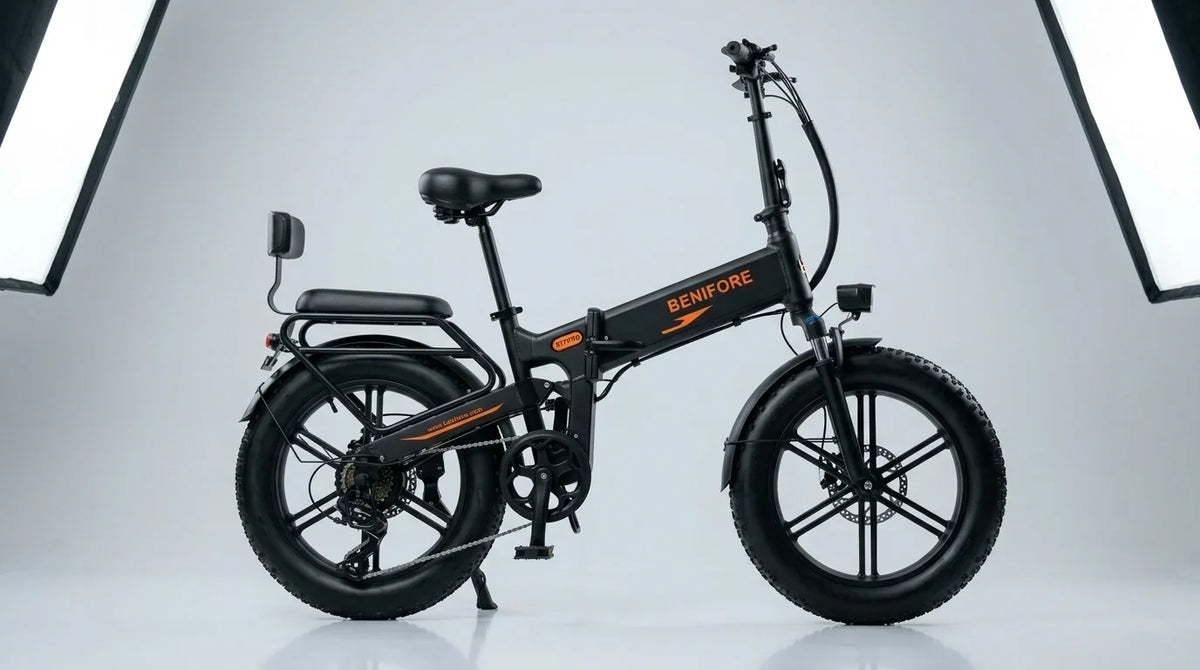
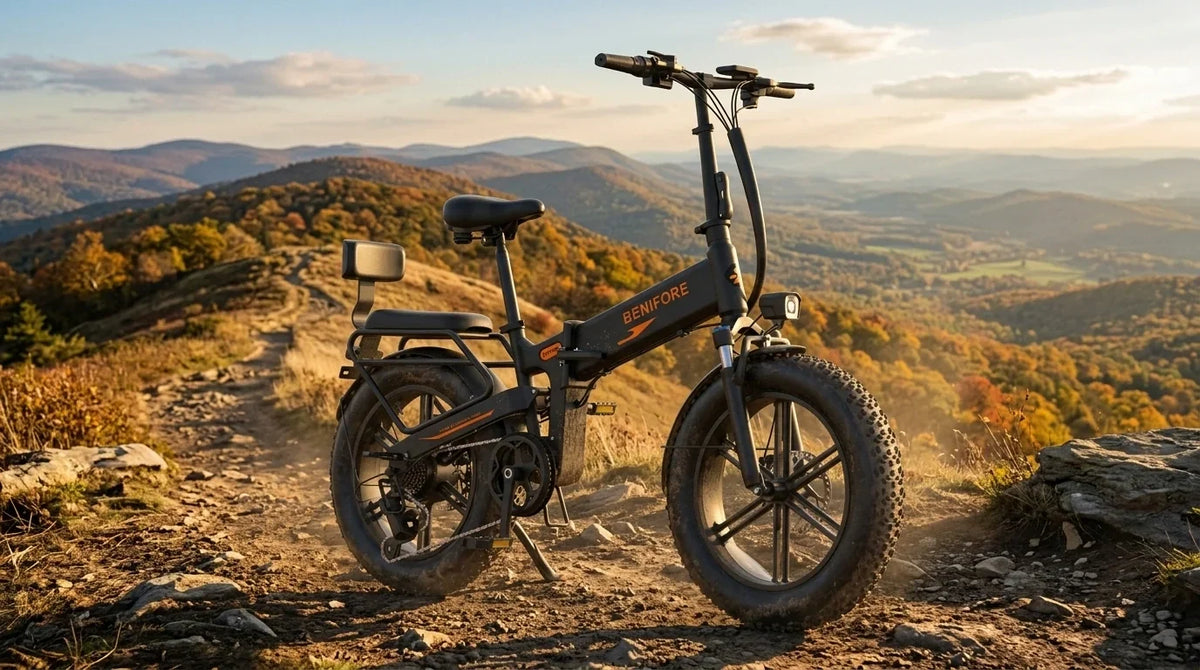
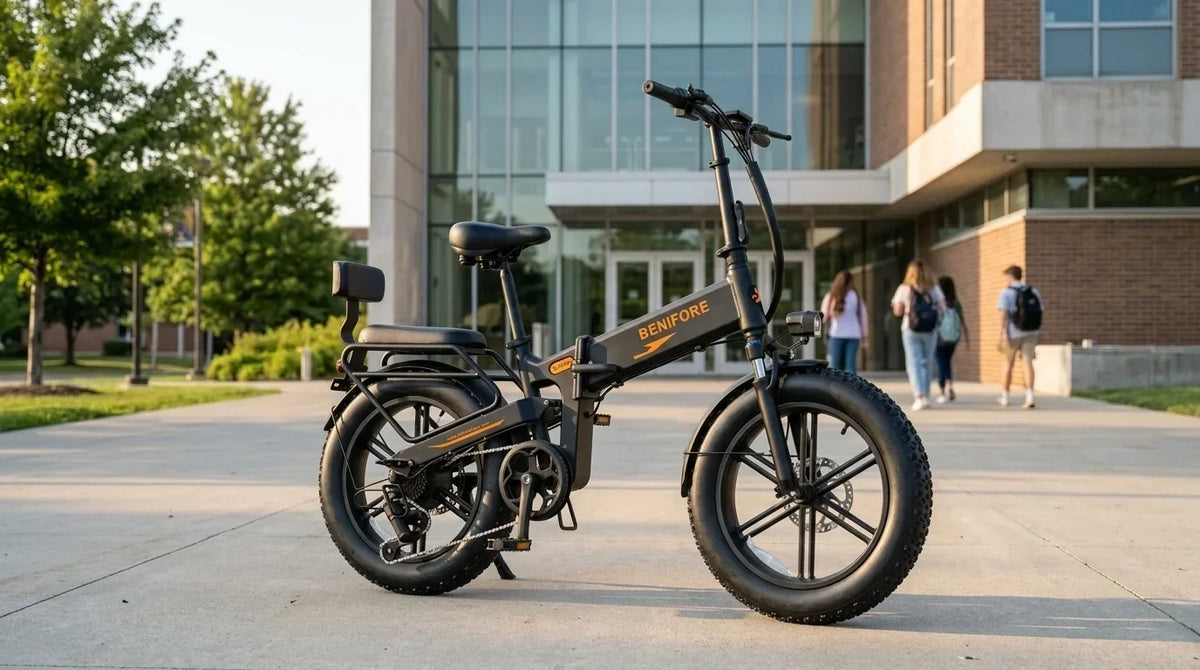
The Benifore X1T PRO is designed around a combination of power, stability, range, and practical carrying capability.
Its specifications include:
- 750W rated motor
- Up to 1500W peak output
- Up to 90Nm torque
- 48V 20Ah battery
- Up to 65 miles of advertised range
- 35 MPH top speed
- 20×4.0 fat tires
- Full suspension
- Up to 400 lbs payload capacity
These specifications make the X1T PRO suitable for riders who want one electric bike for multiple parts of their lifestyle.
For outdoor riders, several features stand out.
The 20×4.0 tires provide a wide contact area for mixed surfaces, while the full-suspension setup is designed to improve comfort when the route becomes less predictable.
The high payload rating is also useful for riders who need to carry additional equipment.
The 48V 20Ah battery provides substantial energy capacity, while the motor system provides the power needed for different types of terrain.
Of course, actual performance will depend on rider weight, cargo, terrain, speed, temperature, tire pressure, and riding mode.
That distinction matters when evaluating any electric bike.
Specifications provide a starting point, but real-world use depends on how the bike is configured and where it is ridden.
Beyond Hunting: One Bike for Multiple Outdoor Activities
One advantage of choosing a versatile electric bike is that it does not need to be used for only one activity.
The same characteristics that make an eBike useful for hunting can also benefit:
- Fishing
- Camping
- Trail exploration
- Weekend riding
- Rural transportation
- Outdoor photography
- Property exploration
This can make a capable electric bike more practical for riders who want to use it throughout the year.
Instead of purchasing a bike for one specific purpose, riders can choose a platform that supports several types of outdoor riding.
Common Mistakes When Choosing a Hunting Electric Bike
Mistake 1: Looking Only at Motor Wattage
Motor wattage is important, but it does not tell the whole story.
Torque, battery capacity, rider weight, tires, gearing, and terrain all affect performance.
Mistake 2: Choosing Based Only on Maximum Range
Maximum range is usually measured under specific conditions.
Real-world range varies considerably.
Always consider your own riding environment.
Mistake 3: Ignoring Payload Capacity
An outdoor trip often involves more equipment than everyday riding.
Make sure the total rider and cargo weight stays within the manufacturer's limits.
Mistake 4: Prioritizing Speed Over Control
Outdoor trails require different riding behavior from open pavement.
A stable, predictable bike can be more useful than one that simply has a higher top-speed number.
Mistake 5: Forgetting Maintenance
Outdoor riding exposes an eBike to more dirt, moisture, dust, and vibration.
Regular cleaning and inspection can help identify problems before they become larger issues.
Final Thoughts
An electric bike can be a practical transportation option for outdoor enthusiasts who want to travel farther and explore more freely.
For hunting-related riding, the best eBike is not necessarily the one with the highest top speed or the biggest motor.
Instead, look at the complete system.
A capable outdoor eBike should offer:
- Strong and controllable motor performance
- Useful battery capacity
- Stable tires
- Comfortable suspension
- Reliable braking
- Sufficient payload capacity
- A practical riding position
- Durable components
Just as importantly, riders should understand their terrain, plan their battery usage, secure their equipment, and follow local access and eBike regulations.
The right electric bike can make the trip to an outdoor destination easier, more flexible, and more enjoyable.
For riders who spend their weekends exploring roads and trails rather than staying on pavement, that versatility can be one of the most valuable characteristics an eBike offers.
Share: